
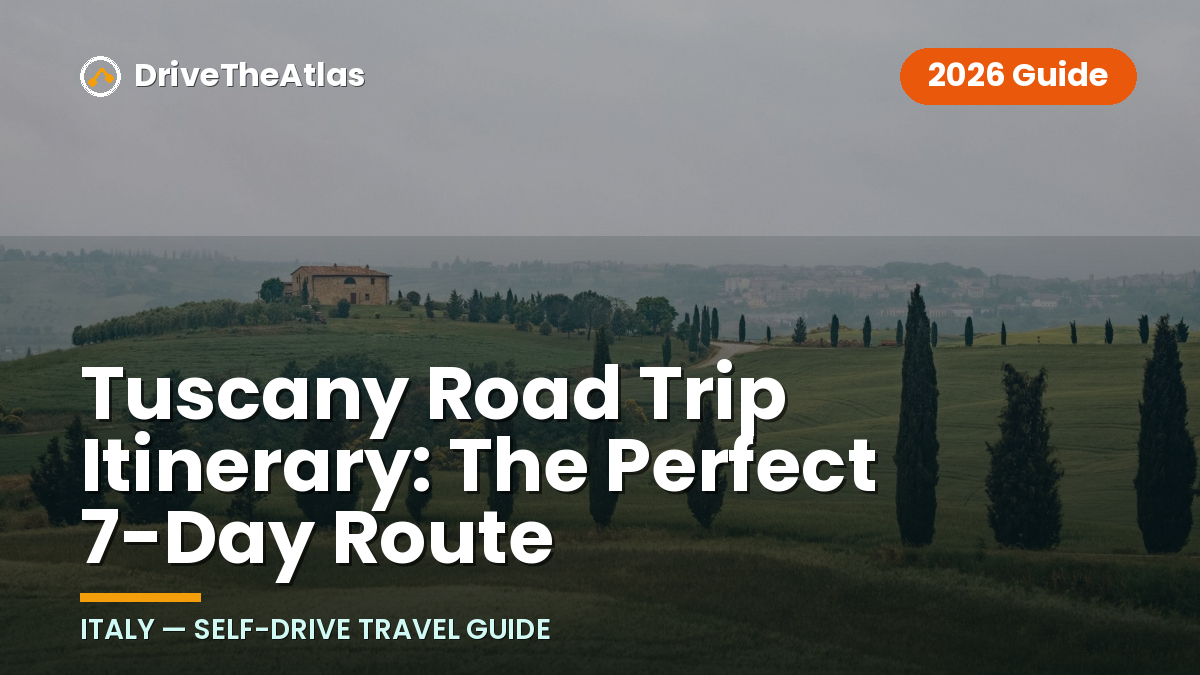
A well-planned Tuscany road trip itinerary is the easiest way to experience the region beyond the postcard highlights. Trains work well between major cities, but the Tuscany most travelers dream about—cypress-lined lanes, vineyard lunches, medieval hill towns, and golden Val d’Orcia views—opens up best by car.
This 7-day route is designed for first-timers who want a scenic, practical, and not-too-rushed introduction to Tuscany by car. You will start and end in Florence, loop through Chianti, Siena, San Gimignano, Val d’Orcia, Montalcino, and finish with either Volterra or Cortona depending on your travel style.
Free cancellation on most bookings · No hidden fees
Why a Tuscany Road Trip Itinerary Is the Best Way to See the Region
A great Tuscany road trip itinerary gives you freedom without turning the week into a driving marathon. The goal is not to visit every famous town in Tuscany; it is to connect the right places in the right order, with enough time to enjoy them.
In practice, Tuscany rewards slow mornings, scenic detours, and countryside stays. A car lets you reach the vineyards, farm stays, viewpoints, and smaller villages that are difficult or time-consuming by public transport.
Why driving beats trains for this itinerary
Trains are useful for Florence, Pisa, Lucca, and other larger towns, but they are less convenient for classic countryside routes. Places like Pienza, San Quirico d’Orcia, Montalcino, and many Chianti villages are much easier with a car.
Driving in Tuscany also lets you choose your rhythm. You can stop for a roadside photo, linger over lunch, or take the quieter back road instead of planning around limited bus schedules.
For this Tuscany road trip itinerary, the car is not just transportation. It is what makes the route possible.
Who this 7-day route is best for
This route is best for travelers who want a balanced mix of towns, wine country, scenic drives, and countryside atmosphere. It works especially well for couples, small groups, families with older children, and anyone who enjoys slow travel with structure.
It is also first-time-friendly. You will see Florence, Chianti, Siena, San Gimignano, Val d’Orcia, Montalcino, and one final cultural stop without changing hotels every single night.
If you want the easiest version of this trip, keep your bases simple and avoid squeezing in Pisa, Lucca, the coast, and Assisi during the same week.
How much you can realistically see in one week
A tuscany road trip 7 days plan should feel scenic, not exhausting. In one week, you can comfortably see three major areas: Chianti and Siena, the San Gimignano countryside, and Val d’Orcia with Montalcino.
You will not see every hill town, and that is a good thing. Tuscany is better when you choose fewer stops and enjoy them properly.
A realistic week includes:
- 2 nights around Chianti and Siena
- 1 extra night for San Gimignano or Siena
- 2 nights in Val d’Orcia or Montalcino
- 1 final night near Volterra, Cortona, Chianti, or back in Florence
This Tuscany road trip itinerary keeps daily driving manageable while still delivering the classic landscapes most travelers come for.
Quick Trip Overview: The 7-Day Tuscany Road Trip Itinerary at a Glance
This loop starts in Florence, heads south through Chianti and Siena, explores the famous hill-town belt, then returns north after Val d’Orcia and wine country. It is a logical route with minimal backtracking.
Florence is the most practical pickup point for most travelers, especially if you arrive by train or fly into Florence Airport. Rome can also work, but it usually adds more driving unless you plan to continue south after Tuscany.
Recommended starting point
Start in Florence if you can. Spend your Florence sightseeing days before picking up the car, because you do not need a vehicle in the historic center.
The best approach is to collect your rental car on the morning you leave Florence. That way, you avoid city parking costs and reduce the risk of accidentally entering restricted traffic areas.
If you are flying into Italy, you can compare airport and city rental options with this guide to [car rental in Italy airport guide](/car-rental-in-italy-airport).
Route direction: north-to-south or south-to-north
For most travelers, north-to-south is easiest:
- Florence
- Chianti
- Siena
- San Gimignano
- Val d’Orcia
- Montalcino
- Volterra or Cortona
- Florence
This flow builds beautifully. You start with vineyards and villages, move into Siena’s medieval grandeur, then reach the wide-open landscapes of Val d’Orcia.
You can reverse the route if you start in Rome. In that case, consider beginning with Montepulciano or Cortona, then working north toward Siena, Chianti, and Florence.
Best bases for each night
Here is a simple base plan for this 7 day Tuscany itinerary.
| Night | Best Base | Why It Works |
|---|---|---|
| Night 1 | Chianti countryside | Easy first drive from Florence, peaceful vineyard setting |
| Night 2 | Siena or just outside Siena | Great base for the city and nearby countryside |
| Night 3 | Siena, San Gimignano, or countryside between them | Reduces rushing on the San Gimignano day |
| Night 4 | Pienza, San Quirico d’Orcia, or Montepulciano | Best access to Val d’Orcia scenery |
| Night 5 | Montalcino or Val d’Orcia | Ideal for Brunello country and slow wine-country travel |
| Night 6 | Volterra, Cortona, Chianti, or Florence outskirts | Sets up an easier final return |
| Night 7 | Florence or onward destination | Best for departures or extra city time |
Approximate driving rhythm for this Tuscany road trip itinerary
Most driving days are 45 minutes to 2 hours total, not counting scenic stops. Day 4 and Day 6 can be longer depending on your choices, but the route is still comfortable if you avoid adding too many towns.
A good rule: plan one main town, one smaller stop, and one scenic meal or viewpoint per day. That rhythm keeps the Tuscany road trip itinerary enjoyable instead of rushed.
Day 1: Florence to Chianti
Your first driving day should be simple. Leave Florence, ease into the countryside, and spend the afternoon in Chianti rather than trying to cover too much ground.
Florence to central Chianti usually takes around 45 minutes to 1 hour 15 minutes, depending on traffic, pickup location, and your chosen village.
Morning pickup and city exit tips
Pick up your car after breakfast and leave Florence before midday if possible. Florence has ZTL zones, which are restricted traffic areas where unauthorized vehicles can receive fines.
Do not drive into the historic center unless your hotel gives precise instructions and confirms vehicle access. If you are unfamiliar with Italian restricted zones, read this guide to [Italy ZTL zones explained](/italy-ztl-zones) before your trip.
For the smoothest start, choose a rental pickup location outside the tightest historic streets or at the airport if that works with your arrival plans.
Scenic drive through Chianti
Chianti is the perfect soft landing for driving in Tuscany. The roads are winding but manageable, the distances are short, and the landscape immediately feels like classic Tuscany.
Aim for the SR222, often called the Chiantigiana road, which connects Florence and Siena through wine country. It is not a road to rush; it is a route for views, vineyard entrances, stone farmhouses, and slow curves.
This first day sets the tone for the rest of your Tuscany road trip itinerary: drive less, stop well, and leave space for spontaneous moments.
Best stops: Greve, Panzano, Castellina
Choose one or two villages instead of all three if you arrive later in the day.
| Stop | Best For | Practical Note |
|---|---|---|
| Greve in Chianti | Main square, easy first stop, wine shops | Good introduction to Chianti |
| Panzano | Lunch, butcher shops, views | Great if you want a food-focused stop |
| Castellina in Chianti | Medieval streets, relaxed evening | Lovely overnight option |
For most travelers, Greve plus Panzano makes a relaxed first day. If you prefer a quieter overnight, look for a countryside agriturismo between Panzano and Castellina.
Day 2: Chianti to Siena
Day 2 is a short transition from the vineyards of Chianti to Siena, one of Italy’s most atmospheric medieval cities. The driving is easy, so you can enjoy the countryside before arriving.
Depending on your base, Chianti to Siena often takes 45 minutes to 1 hour 15 minutes. Leave time for parking and walking into the historic center.
What to see before arriving in Siena
Before heading straight to Siena, consider one last Chianti stop. Castellina in Chianti is a good choice if you did not visit on Day 1.
You could also take a scenic drive through Radda in Chianti or Gaiole in Chianti. Both are useful if you want a quieter, more rural morning.
Do not overload the day. Siena deserves real time, and your Tuscany road trip itinerary will feel better if you arrive by early afternoon.
Best viewpoints and lunch stops
For lunch, choose either a countryside trattoria before Siena or a simple meal once you arrive. Siena’s historic center has many options, but parking outside the walls and walking in takes time.
Once inside Siena, prioritize:
- Piazza del Campo
- Siena Cathedral
- Torre del Mangia area
- The contrade neighborhoods
- Sunset viewpoints near the city edges
If you only have one paid attraction in you, make it Siena Cathedral. The interior is extraordinary, and it gives the day a clear highlight.
Where to sleep in or near Siena
You have two smart choices: stay inside Siena’s historic center without using your car, or stay just outside the walls with easier parking.
Inside the center is atmospheric but requires careful planning around ZTL access and luggage. Outside the walls is more practical for travelers using Siena as a road trip base.
For a first trip, I usually prefer staying just outside the historic core or at a countryside property within 10–20 minutes of Siena. It makes the next two days of this Tuscany road trip itinerary much easier.
Day 3: Siena to San Gimignano and the Surrounding Hills
San Gimignano is one of Tuscany’s most famous towns, and it can feel busy. Still, it deserves a proper visit because its skyline, towers, and surrounding countryside are genuinely special.
From Siena, the drive to San Gimignano is usually around 45 minutes to 1 hour. Go early or late in the day for the best experience.
Why San Gimignano deserves a full visit
San Gimignano is not just a quick photo stop. The town’s medieval towers, stone lanes, and views over the countryside make it one of the strongest highlights in this Tuscany road trip itinerary.
Arrive in the morning, park outside the walls, and walk in. Give yourself time to wander beyond the main square, where the crowds thin out quickly.
A simple time plan:
- 9:00–10:00: Drive from Siena
- 10:00–12:30: Explore San Gimignano
- 12:30–14:00: Lunch
- Afternoon: Countryside detour or return slowly toward your base
Optional countryside detours
If you want more than a San Gimignano day trip, add one countryside stop instead of another major town. Good options include Certaldo Alto, Monteriggioni, or a scenic vineyard lunch nearby.
Monteriggioni is especially easy if you are driving between Siena and San Gimignano. It is small, walled, and quick to visit without derailing the day.
Certaldo Alto is quieter and pairs well if you are staying northwest of Siena or near San Gimignano.
Food and wine ideas
This area is known for Vernaccia di San Gimignano, a local white wine that makes a refreshing change from the reds of Chianti and Montalcino.
Plan tastings carefully if you are driving. A long lunch with one glass is very different from multiple winery visits, and the driver should stay well within legal and personal limits.
If food is your priority, book a countryside lunch and keep the rest of the afternoon flexible. That approach usually makes this part of a Tuscany road trip itinerary feel more memorable than racing between towns.
Day 4: Val d’Orcia Road Trip Day
Day 4 is the visual centerpiece of the trip. If you picture Tuscany as rolling wheat fields, cypress-lined roads, soft hills, and Renaissance hill towns, you are probably picturing Val d’Orcia.
This Val d’Orcia road trip works best when you sleep nearby, ideally in Pienza, San Quirico d’Orcia, Montepulciano, or the countryside between them.
Pienza
Pienza is one of the best towns in Tuscany for first-time visitors. It is compact, beautiful, and perfectly positioned for views across Val d’Orcia.
Walk the main street, step onto the panoramic path, and leave time for a slow lunch or pecorino tasting. Pienza is famous for pecorino cheese, and it is an easy place to enjoy local flavors without overplanning.
For many travelers, Pienza is the prettiest and most practical base in this part of the Tuscany road trip itinerary.
Montepulciano
Montepulciano is larger and steeper than Pienza, with grand architecture, wine cellars, and sweeping views. It is a strong afternoon stop if you are comfortable with hills and parking outside the center.
The drive between Pienza and Montepulciano is one of the most rewarding stretches of the route. Allow extra time because you will want to stop for photos.
If you plan a wine tasting here, consider doing it once the car is parked for the day or keep it modest if you still need to drive.
Bagno Vignoni or San Quirico d’Orcia
Bagno Vignoni is small and unusual, with a thermal pool forming the center of the village. It is quick to visit and pairs beautifully with Pienza or San Quirico d’Orcia.
San Quirico d’Orcia is a practical, less flashy base with easy access to surrounding roads. It is also close to some of the area’s most iconic cypress views.
If you want a relaxed day, choose Pienza, San Quirico, and one scenic drive rather than adding every possible village.
Best scenic drives and photo stops
The best part of Day 4 is not any single town. It is the road between them.
Look for scenic routes around:
- Pienza to San Quirico d’Orcia
- San Quirico d’Orcia to Bagno Vignoni
- Pienza to Montepulciano
- The countryside near the Chapel of the Madonna di Vitaleta
- Cypress-lined lanes near San Quirico d’Orcia
Be respectful when stopping for photos. Use proper pull-offs, do not block farm roads, and avoid entering private fields.
This is the day your Tuscany road trip itinerary truly becomes about the landscape.
Free cancellation on most bookings · No hidden fees
Day 5: Montalcino and Brunello Country
Day 5 keeps you in southern Tuscany but shifts the focus toward Montalcino and Brunello wine country. It is a slower, richer day with shorter drives and big views.
Montalcino is usually 30–45 minutes from Pienza or San Quirico d’Orcia, depending on your route.
Morning in Montalcino
Start the morning in Montalcino before the day gets too busy. Park outside the center and walk up into town.
The fortress area has excellent views, and the streets are full of wine shops and small places to eat. Even if you are not a serious wine traveler, Montalcino belongs in this Tuscany road trip itinerary because the setting is spectacular.
Give yourself time to wander rather than treating it as a quick tasting stop.
Wine tasting planning tips
Brunello tastings are best planned in advance, especially in busier travel periods. Choose one winery or one structured tasting rather than trying to visit several in one afternoon.
A practical plan:
- Morning: Montalcino town
- Lunch: Countryside restaurant or winery lunch
- Afternoon: One pre-booked tasting
- Evening: Stay nearby or return to your Val d’Orcia base
This keeps the day enjoyable and reduces unnecessary driving.
How to keep driving safe after tastings
Wine-country road trips require common sense. If one person is driving, that person should limit or skip tastings, use spittoons, or choose experiences focused more on cellar visits and food.
Another smart option is to book a taxi or private transfer for a dedicated wine afternoon. It may cost more, but it removes stress and keeps everyone safe.
The best Tuscany road trip itinerary is one you remember for the right reasons. Plan tastings around short distances, generous meal breaks, and a responsible driver.
Day 6: Volterra or Cortona as a Cultural Side Trip
Day 6 gives you a choice, which is important because not every traveler’s route will be identical. Volterra and Cortona are both excellent, but they serve different versions of the trip.
Choose Volterra if you want an atmospheric Etruscan hill town and a smoother return toward western or central Tuscany. Choose Cortona if you are staying near Montepulciano or want an elegant eastern Tuscany finish.
Which town to choose based on your route
Volterra works well if you are moving back north toward Florence, San Gimignano, or the Pisa/Lucca side of Tuscany. It has a dramatic hilltop setting, ancient history, and a slightly quieter feel than San Gimignano.
Cortona works well if your final Val d’Orcia base is Montepulciano or the eastern side of Tuscany. It is graceful, steep, and full of views over the Val di Chiana.
For this Tuscany road trip itinerary, do not try to visit both in one day. They sit in different directions, and combining them creates too much driving.
How to avoid too much driving
The key is to choose your Day 6 town based on where you slept on Night 5.
| If You Slept Near… | Choose… | Why |
|---|---|---|
| Pienza or San Quirico d’Orcia | Volterra or Cortona | Either works, depending on final destination |
| Montepulciano | Cortona | Shorter, more natural route |
| Montalcino | Volterra | Better if returning north/west |
| Siena | Volterra | Easier cultural day with less backtracking |
If you are tired by Day 6, skip the side trip and spend the day slowly returning through Chianti. A good Tuscany road trip planner should always include permission to simplify.
Best way to spend the afternoon
In Volterra, focus on the historic center, viewpoints, Etruscan heritage, and alabaster shops. The town feels older and moodier than many Tuscan villages, which makes it a great contrast to Val d’Orcia.
In Cortona, wander uphill through the lanes, stop for a long lunch, and enjoy the views. It is a town for slow exploration rather than checklist sightseeing.
For your final overnight, choose either the town itself, a countryside stay nearby, or a location that makes the drive to Florence manageable the next morning.
Day 7: Return to Florence and Final Scenic Stops
The last day should be easy. Many travelers underestimate the time needed for fueling, navigating city edges, returning the car, and reaching a train station or airport.
Build in a buffer. A smooth final day is better than one last rushed hill town.
Easy final-morning ideas
If you stayed in Volterra, consider a slow breakfast and a short walk before driving to Florence. If you stayed near Cortona, enjoy one last viewpoint before heading north.
If you are already near Chianti, you can stop in a small village for coffee or lunch. Do not add a major detour unless your departure is late.
The final day of this Tuscany road trip itinerary is about landing the trip well, not adding stress.
Returning the car without stress
Before returning the car, allow time to refuel according to your rental agreement and inspect the vehicle. Keep receipts if needed and take quick photos of the car at drop-off.
If returning in Florence, confirm the exact return address and avoid driving into restricted central areas by mistake. Rental offices can be close to ZTL boundaries, so follow the company’s instructions carefully.
For broader rental logistics, this guide to [car rental in Italy: the complete guide](/car-rental-in-italy) is useful before departure.
Extra time in Florence if you have a late flight
If you have a late flight or train, return the car first, store luggage, and spend your remaining time in Florence on foot. That is much easier than trying to park and sightsee with a vehicle.
Good final options include a walk along the Arno, a visit to the Oltrarno, or one last meal near Santo Spirito. Florence is the right place to end this route because it reconnects you to trains, airports, and onward travel.
Where to Rent a Car for Your Tuscany Road Trip Itinerary
A rental car makes this route practical, but the best choice is not the biggest or flashiest vehicle. For most travelers, the best car is the one that is easy to park, comfortable on country roads, and simple to manage in village lots.
This is where planning ahead matters. Tuscany is popular, and the easiest pickup locations and vehicle categories can become more limited during busy periods.
Best pickup locations
Florence is usually the best pickup point for a Tuscany car rental. You can collect the car after visiting the city, drive into the countryside, and return it before spending more time in Florence or traveling onward.
Common pickup options include:
- Florence Airport
- Florence city rental offices
- Major train-station-area rental locations
- Rome, if your wider Italy route starts there
- Pisa, if arriving through Pisa Airport
Airport pickups can be convenient, but city pickups may work better if you are already in Florence. Compare both based on your arrival plans, luggage, and comfort with city driving.
What type of car works best
A compact car is usually easiest for driving in Tuscany. Village streets can be narrow, parking spaces can be tight, and countryside accommodations sometimes have gravel drives or small lots.
You do not need a large vehicle unless your group or luggage requires it. In practice, smaller cars make this Tuscany road trip itinerary less stressful.
If you need more space, compare options carefully. DiscoverCars lists rental categories including vans and SUVs, but for most first-time Tuscany travelers, compact or economy-style vehicles are easier to live with.
Why booking in advance matters
Booking ahead gives you more time to compare pickup points, vehicle sizes, supplier options, insurance choices, and booking conditions. It also helps you avoid making a rushed decision after a long flight.
For a practical comparison tool, I’d use DiscoverCars to compare car rental options in mainland Italy. Its official homepage highlights comparing rental deals, access to member-only deals, managing bookings in one place, help resources, multiple currencies, multiple languages, and supplier lists.
I would still read the rental terms carefully before booking. There are no verified DiscoverCars pricing plans or prices available from the provided official pricing page, so compare the actual live offers, conditions, and coverage details shown during your search.
Driving Tips for Tuscany
Driving in Tuscany is very doable, but it is not the same as driving on wide suburban roads. The main challenges are ZTL zones, tight parking, narrow lanes, and knowing when not to follow your GPS blindly.
A little preparation makes this Tuscany road trip itinerary much smoother.
ZTL zones and parking
Many Tuscan towns have ZTL zones, especially historic centers. These restricted areas are monitored, and rental cars are not automatically exempt.
Always park outside the old town walls unless your accommodation confirms access and explains the process. Look for signed public parking lots, then walk in.
Before you go, read [Italy ZTL zones explained](/italy-ztl-zones). It can save you from one of the most common rental-car mistakes in Italy.
Mountain roads and narrow lanes
Tuscany’s roads are scenic, but they can be curvy and narrow. Drive slowly, expect cyclists and farm vehicles, and use caution on blind bends.
Do not rely only on estimated drive times from mapping apps. A 35-minute drive can take longer if you stop for photos, get stuck behind a tractor, or navigate a steep village road.
For most travelers, daylight driving is more comfortable. This is especially true on the rural parts of a Tuscany road trip itinerary, where lighting can be limited.
Fuel, tolls, and insurance basics
Fuel stations are common near larger roads and towns, but rural stations may have limited service hours or automated pumps. Do not wait until the tank is nearly empty in the countryside.
This route mostly uses regional roads, but you may encounter toll roads if connecting from airports, Rome, Pisa, or other parts of Italy. For a broader overview, read [Driving in Italy tolls and rental car tips](/driving-in-italy-tolls).
Insurance is another area to understand before you book. Rental coverage terms vary, so review deductibles, exclusions, deposits, and optional coverage carefully. This guide to [Italy car rental insurance explained](/italy-car-rental-insurance) is a good starting point.
Road conditions, opening hours, parking access, winery schedules, and attraction entry rules can change. Verify locally before departure, especially during holidays, harvest season, or major events.
Where to Stay Each Night
Your accommodation strategy can make or break a Tuscany road trip itinerary. The right bases reduce driving time, simplify parking, and give you more of the countryside atmosphere that makes the trip special.
Do not choose hotels only by charm. Look at the route, parking, access roads, and whether you want to walk to dinner.
Best base towns for a 7-day loop
For a smooth first-time loop, use these bases:
| Trip Segment | Best Base Options | Why |
|---|---|---|
| Chianti | Greve, Panzano, Castellina, countryside agriturismo | Easy vineyard access and relaxed first night |
| Siena area | Siena outskirts, countryside near Siena | Best for Siena plus San Gimignano |
| Val d’Orcia | Pienza, San Quirico d’Orcia, Montepulciano | Best scenic access |
| Montalcino area | Montalcino or Val d’Orcia countryside | Good for Brunello country |
| Final night | Volterra, Cortona, Chianti, or Florence | Depends on return plan |
If you want fewer hotel changes, stay 2 nights near Siena and 2 nights in Val d’Orcia. That is usually the best compromise between convenience and atmosphere.
Countryside agriturismo vs. central hotel
An agriturismo gives you countryside views, quiet evenings, and often easier parking. It is ideal if you want the classic Tuscany by car experience.
A central hotel gives you walkable dinners and nighttime atmosphere, but parking can be more complicated. It also increases the need to understand ZTL rules.
For most travelers following this Tuscany road trip itinerary, I recommend a mix: countryside stays in Chianti and Val d’Orcia, plus one town-based stay in or near Siena.
How to reduce driving time
The easiest way to reduce driving time is to stop changing regions every night. Group your sightseeing by area.
For example:
- Visit Chianti while sleeping in Chianti.
- Visit Siena and San Gimignano from one base.
- Visit Pienza, Montepulciano, San Quirico d’Orcia, and Montalcino from a Val d’Orcia base.
- Choose either Volterra or Cortona, not both.
This sounds simple, but it is the difference between a relaxing trip and a constant luggage shuffle.
Free cancellation on most bookings · No hidden fees
FAQ
How many days do you need for a Tuscany road trip?
Seven days is enough for a strong first-time Tuscany road trip if you focus on one coherent regional loop. A Tuscany road trip itinerary of 10–14 days lets you slow down, add Lucca or the coast, and stay longer in wine country.
For most travelers, one week is the sweet spot for Florence, Chianti, Siena, San Gimignano, Val d’Orcia, Montalcino, and one final hill town.
What is the most scenic drive in Tuscany?
The most scenic drive in Tuscany is usually Val d’Orcia, especially the roads between Pienza, San Quirico d’Orcia, Montalcino, and Montepulciano. This area has the rolling hills, cypress trees, stone farmhouses, and open views travelers expect from Tuscany.
If your Tuscany road trip itinerary includes only one big countryside driving day, make it Val d’Orcia.
Where should I go for a Tuscany road trip?
For a 7-day route, prioritize Florence or Chianti, Siena, San Gimignano, Val d’Orcia, Montalcino, and one cultural side trip such as Volterra or Cortona. This gives you a balanced mix of cities, villages, vineyards, and scenic roads.
Avoid adding too many distant places. Tuscany is best when you leave space for slow lunches, viewpoints, and unplanned stops.
What is the prettiest town in Tuscany?
There is no single answer, but many travelers rank Pienza, San Gimignano, and Montepulciano among the prettiest towns in Tuscany. Pienza is elegant and scenic, San Gimignano has the famous towered skyline, and Montepulciano combines views, wine, and grand architecture.
If I had to choose one for a first-time Tuscany road trip itinerary, I would pick Pienza for beauty, ease, and access to Val d’Orcia.
A thoughtful Tuscany road trip itinerary is about more than connecting famous names on a map. Keep the route simple, rent a car that is easy to handle, respect ZTL and parking rules, and give yourself time to enjoy the roads between the towns. That is where Tuscany becomes unforgettable.