
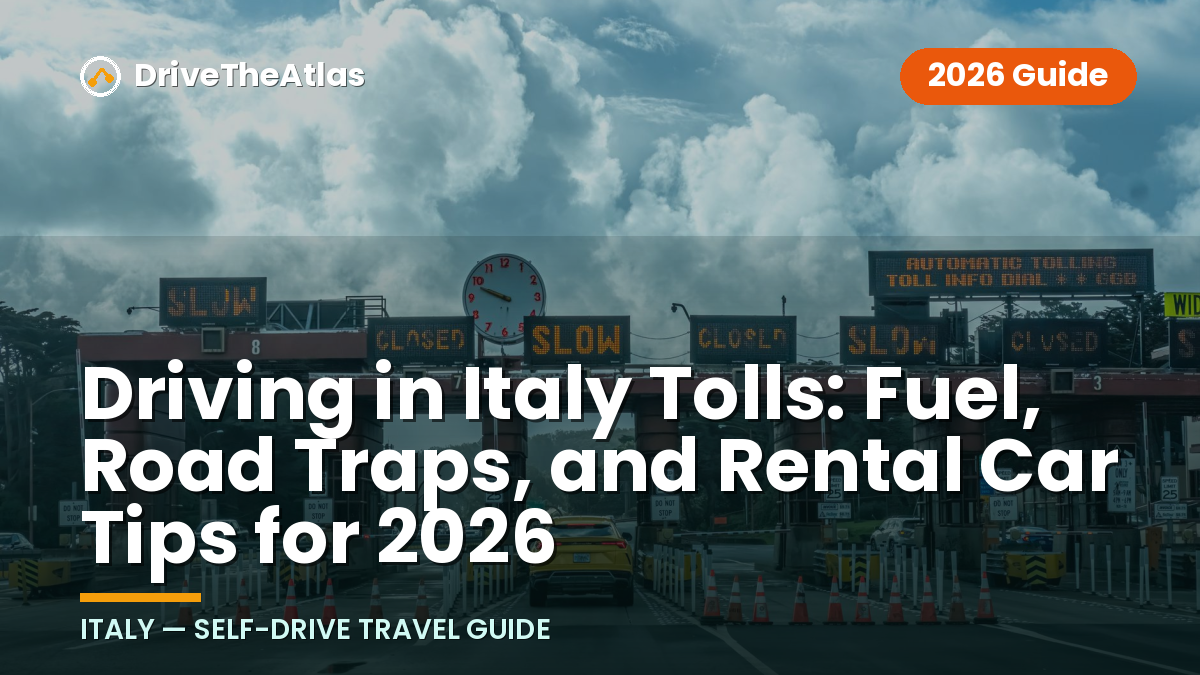
If you are researching driving in italy tolls before a first rental-car trip, you are already avoiding one of the most common tourist mistakes: assuming the road system works like it does at home. In Italy, many fast motorways are tolled, fuel stations may charge different prices depending on how you pump, and city centers can trigger fines before you even realize you entered a restricted zone.
This guide is written for nervous but prepared travelers. It explains Italian motorway tolls, rental-car payment choices, Telepass Italy lanes, ZTL Italy zones, Italian speed cameras, fuel-station surprises, and the small decisions that can save you from extra charges.
Free cancellation on most bookings · No hidden fees
Quick answer: what foreign drivers need to know before driving in Italy
Are Italian motorways toll roads?
Yes, many major Italian motorways, known as autostrade, are toll roads. These are usually the fastest routes between big cities, airports, lakes, coastal areas, and major tourist regions.
Not every road in Italy is tolled. You can often choose slower state roads or regional roads, but if you are covering long distances, Italy toll roads are usually more efficient and less stressful than winding through towns.
The key point for driving in italy tolls is simple: do not treat a toll plaza like a parking-garage barrier. Lane choice matters, ticket handling matters, and using the wrong lane can create avoidable admin later.
What is the basic toll process?
On most ticket-based motorways, the process works like this:
- Enter the autostrada.
- Take a ticket from the machine unless you are using a valid electronic toll device.
- Keep the ticket safe.
- Exit the autostrada.
- Insert or hand over the ticket.
- Pay the calculated toll by cash, card, or approved electronic method.
The toll is normally based on where you entered, where you exited, and the vehicle class. A normal rental car is generally treated as a standard passenger vehicle, but larger vans or camper-style vehicles can cost more.
Cash, card, or Telepass: which lane should tourists use?
Most tourists should use clearly marked cash or card lanes unless the rental company has specifically provided and activated a Telepass-style device. Telepass Italy lanes are for vehicles with compatible electronic toll equipment.
If you do not have a device, avoid lanes marked only for Telepass. Do not follow the car in front just because the barrier opens for them. Their transponder may be paying automatically, while your rental car may trigger an unpaid toll record.
For anxious first-timers, the safest strategy is to slow down before the toll plaza, read the overhead signs, and choose a lane with card symbols, cash symbols, or a staffed booth.
How tolls in Italy actually work
Entering the autostrada: take the ticket
When entering a ticket-based autostrada, look for lanes where you can collect a ticket. The machine will usually issue a small paper ticket after you press a button or when the system detects your vehicle.
Take the ticket and store it somewhere obvious, such as a cupholder or the rental-car document folder. Do not put it loose in a pocket or between seats. Losing it is one of the easiest ways to make driving in italy tolls more expensive and stressful than necessary.
A simple flow helps:
| Stage | What to do | What not to do |
|---|---|---|
| Entry | Take a ticket from the machine | Enter a Telepass-only lane without a device |
| During drive | Keep the ticket dry and visible | Leave it in a jacket pocket or luggage |
| Exit | Use the ticket to calculate payment | Drive away without resolving the toll |
Exiting and paying the toll
At the exit toll plaza, the system calculates the price based on the ticket. In automated lanes, you insert the ticket first, then pay when the amount appears. In staffed lanes, you hand the ticket to the operator and pay directly.
Payment options vary by lane, so look before committing. Some lanes accept cards, some cash, some both, and some are electronic-only. If you are unsure, a staffed booth is often the least intimidating option.
For how to pay tolls in Italy, the practical answer is: ticket first, payment second, receipt if offered. Keep the receipt until after your trip, especially if you are in a rental car.
What happens if you lose the ticket
If you lose your toll ticket, the system may not know where you entered. That can lead to a higher charge or a process to declare your entry point. Rules and outcomes can vary, so treat the ticket like a boarding pass.
If this happens, do not panic and do not reverse in a toll lane. Use the assistance button, speak to staff if available, and explain that the ticket is lost. It is better to resolve the issue at the booth than ignore it and create a rental-company charge later.
How toll prices are calculated
Italian autostrada tolls are generally calculated by distance, route, and vehicle category. Some roads, bridges, tunnels, or special sections may use different systems, but for most visitors the distance-based model is the one to understand.
This is why two drives that look similar on a map may not cost the same. A direct motorway route with tunnels and major infrastructure may cost more than a slower non-motorway alternative.
When planning driving in italy tolls, focus on route logic rather than memorizing prices. Check your route before departure, compare tolled and non-tolled options, and decide whether the time savings justify the cost.
Common signs and lane colors at toll plazas
Italian toll plazas use overhead signs and lane markings to separate payment types. You may see words, symbols, and colors that indicate who should use each lane.
Common indicators include:
| Sign or symbol | Meaning for tourists |
|---|---|
| Telepass | Electronic toll lane; use only if your car has an active compatible device |
| Carte / cards | Card payment lane |
| Contanti | Cash payment |
| Biglietto | Ticket collection or ticket processing |
| Manual/staffed booth symbol | Operator available |
The biggest trap is entering a Telepass-only lane by mistake. If the lane is only for electronic tolling and you do not have the device, you may create an unpaid toll event.
How to pay Italian tolls with a rental car
Cash vs credit card at booths
For most rental-car travelers, cash and credit card payment at the booth is the simplest method. Keep a payment card within reach, but also carry some cash as a backup because machines, cards, and foreign bank authorization can occasionally be unpredictable.
I like to keep a small “driving kit” in the center console: toll ticket, card, coins or small notes, rental agreement, and parking receipt. It sounds basic, but when cars are lining up behind you, having everything ready makes driving in italy tolls feel much less chaotic.
If your card is declined or a machine behaves oddly, do not keep jamming buttons. Use the help button or move only if instructed by staff or the system.
Using a Telepass device from a rental company
Some rental companies may offer an electronic toll device or toll-payment service. Do not assume it is included. Ask at pickup whether the car has a toll transponder, whether it is active, what roads it covers, and what fees or billing rules apply.
If you accept a Telepass Italy device, clarify whether tolls are charged directly to your rental account after the trip. Also ask whether there is a daily service fee, activation fee, or administrative charge. Fees depend on the rental company’s terms, so read the paperwork rather than relying on a verbal summary.
If you are still comparing vehicles before booking, you can compare rental options for mainland Italy through Discover Cars. Its homepage message says “Best Car Rental Deals with Free Cancellation, Compare & Save!” and the site also says users can manage bookings in one place, but you should always confirm toll-device details with the actual rental provider before driving away.
What to check before you drive away
Before leaving the rental lot, ask these questions:
| Question | Why it matters |
|---|---|
| Does this car have a toll device? | Prevents accidental Telepass lane use |
| Is the device active or disabled? | Some devices may be present but not included |
| How are tolls billed? | Helps avoid surprise post-trip charges |
| Are there admin fees for unpaid tolls or fines? | Rental companies often pass on processing costs |
| What is the fuel policy? | Prevents refueling disputes later |
Also inspect the windshield. Toll devices are often mounted near the mirror, but not every box on a windshield is a toll transponder. Ask the desk agent to point it out and explain it.
How toll charges may appear after your trip
If you pay at booths by cash or card, the charge is usually settled immediately. If you use a rental-company toll device, charges may appear later on your card, sometimes after the rental has ended.
Unpaid tolls, fines, or administrative fees can also appear later. This delay surprises many travelers because they think, “I returned the car with no problem.” In reality, motorway operators, municipalities, or enforcement systems may process vehicle records after the fact.
For driving in italy tolls, keep receipts and rental documents for several months. They are useful if you need to understand or dispute a charge.
How much do toll roads in Italy cost in 2026?
Why tolls vary by route and distance
There is no single flat price for Italian motorway tolls. Costs vary by distance, road operator, vehicle class, and specific route. Some corridors are straightforward; others may involve mountain infrastructure, tunnels, or special sections.
Because rates can change and route planners update more frequently than static travel articles, it is safer to budget with current mapping tools rather than rely on old examples. This guide does not pretend to have a live 2026 toll database.
The practical rule: longer autostrada drives cost more, and avoiding tolls usually means accepting slower roads, more roundabouts, more town traffic, and more concentration.
Budgeting for long drives
For long Italian road trips, build tolls into your transport budget the same way you budget fuel and parking. If you are driving from one region to another, expect motorway tolls to be a normal cost of saving time.
A useful planning method:
- Enter your route in a map app.
- Compare “fastest” and “avoid tolls.”
- Note the time difference.
- Check whether the tolled route avoids city centers.
- Decide whether the toll is worth the reduced stress.
This is especially helpful for first-time visitors who are combining major cities with countryside stays. Sometimes the paid motorway is calmer than navigating dozens of local junctions.
Why online route planners help
Online route planners can estimate tolls, fuel, time, and road categories. They are not perfect, but they are useful for understanding whether you are about to spend two hours on an autostrada or ten minutes on a short bypass.
Use more than one tool if the trip is important. Compare your navigation app with motorway operator information where available, especially for long drives.
For driving in italy tolls, the goal is not to know every cent in advance. The goal is to avoid being surprised by the fact that a fast road is tolled at all.
When toll roads are worth it
Toll roads are often worth it when you are traveling between major cities, trying to reach an airport, driving in bad weather, or covering a long distance in one day. They usually have clearer signage, fewer intersections, and more predictable travel times.
They may not be worth it for short scenic drives, city-to-village hops, or trips where the toll route only saves a few minutes. In Tuscany, Umbria, Sicily, Puglia, or the Dolomites, the best route is not always the fastest motorway.
Use Italy toll roads strategically: pay when they reduce stress, skip them when the slower road is part of the experience.
Fuel in Italy: station quirks that can cost extra
Self-service vs full-service pumps
One of the most useful Italy fuel station tips is to understand the difference between self-service and full-service. In Italian, you may see self for self-service and servito for attended service.
Servito usually means an attendant pumps for you, and the per-liter price can be higher. This is normal, not a scam, but it surprises visitors who only looked at the cheaper price on the board.
If you want the lower self-service price, make sure you are at the self-service pump before you start fueling.
Why the price board may differ by mode
Italian fuel stations may display separate prices for self-service and full-service. The board can show multiple fuel types and service modes, so read carefully before pulling in.
Common fuel words include:
| Italian term | Meaning |
|---|---|
| Benzina | Gasoline/petrol |
| Gasolio / Diesel | Diesel |
| Self | Self-service |
| Servito | Full-service |
| GPL | LPG, not standard gasoline |
The most expensive fuel mistake is putting the wrong fuel in the rental car. Check the fuel cap, rental paperwork, and dashboard label before pumping. If you are unsure, ask.
Opening hours and rural fuel stops
Fuel stations on motorways are usually more convenient for long-distance travel, but rural and town stations may have limited staffed hours. During lunch breaks, evenings, Sundays, or holidays, you may need to use an automated machine.
Automated pumps may require prepayment, and not every foreign card works smoothly. If you are heading into rural areas, mountains, or islands, refuel earlier than you would at home.
A good habit is to refuel when the tank drops below half in rural regions. It avoids turning a scenic detour into a stressful hunt for an open station.
Prepay, card holds, and service fees
Some self-service pumps authorize a temporary card hold before dispensing fuel. The final charged amount should reflect the fuel you actually pumped, but the hold may take time to clear depending on your bank.
If the machine asks you to prepay a cash amount, it may dispense only up to that amount. Keep the receipt, especially if the machine does not dispense the full prepaid value or if you need staff assistance.
Fuel issues are not technically part of driving in italy tolls, but they create the same kind of post-trip anxiety: unexplained card activity, receipts in another language, and uncertainty about whether you did something wrong.
Free cancellation on most bookings · No hidden fees
Road traps beyond tolls: the mistakes tourists make most often
ZTL zones and limited traffic areas
ZTL Italy zones are limited traffic areas, usually in historic city centers. They are one of the biggest sources of fines for tourists driving rental cars.
A ZTL is not the same as a normal pedestrian street. It may allow residents, taxis, buses, hotel guests with pre-registration, or delivery vehicles, while blocking unauthorized cars. Cameras can record license plates at entry points.
If your hotel is inside or near a ZTL, contact the hotel before arrival and ask exactly where to drive, where to stop, and whether they can register your plate. Do not assume your rental car is allowed because your accommodation is nearby.
Bus lanes and restricted city-center entries
Bus lanes, taxi lanes, and restricted entries can also trigger fines. These lanes may look tempting when traffic is heavy, but they are often camera-monitored.
Look for markings such as BUS, overhead restrictions, red-circled signs, and lane-specific arrows. In cities like Rome, Florence, Milan, Bologna, and Naples, lane discipline matters because a wrong turn can put you into a restricted area quickly.
The best city-driving advice is simple: park outside the historic center and walk, use public transport, or take a taxi. The money saved in stress and fines can be worth more than the parking fee.
Speed cameras and average-speed enforcement
Italian speed cameras can be fixed, mobile, or part of average-speed enforcement systems. The average-speed system measures travel time between points rather than just one instant speed.
You may see signs warning of controllo elettronico della velocità, autovelox, or Tutor systems. Treat them seriously. Do not accelerate hard after passing one camera if you are on an average-speed corridor.
Italian speed cameras are not just a local-driver concern. Rental-car drivers can receive fines later through the rental company, often with an added administrative fee.
Wrong-lane exits and unexpected fines
Wrong-lane mistakes happen most often at toll plazas, motorway exits, roundabouts, and city gateways. Tourists get nervous, follow the wrong car, or commit too late to a lane.
If you enter the wrong toll lane, do not reverse unless instructed by staff or police. Use the help button and wait for guidance. Reversing in a toll plaza or making sudden lane changes can be more dangerous than the original mistake.
This is why driving in italy tolls is only one part of the bigger trap guide. The real skill is slowing down early, reading signs, and accepting a missed turn rather than making a risky correction.
Italian road signs and lane markings to recognize instantly
Autostrada signs
Autostrada signs are usually green. They indicate motorways and major controlled-access roads. Blue signs are commonly used for other main roads and local routes.
If your navigation directs you toward a green autostrada sign, expect the possibility of a toll system. Not every green-sign moment means immediate payment, but it is your cue to prepare for ticket booths, entry ramps, and faster traffic.
For driving in italy tolls, green signs are your early warning: get your ticket/card system ready before you reach the barrier.
Telepass signage
Telepass signage usually appears in yellow and is clearly marked Telepass. These lanes are designed for electronic toll users.
Do not use these lanes unless your rental company has confirmed that your car has an active compatible device. A windshield-mounted object is not enough proof.
If you accidentally approach a Telepass lane and can safely choose another lane before committing, do so. If you are already trapped in the lane, stop at the barrier and use assistance rather than forcing your way through.
Cash/card lane signage
Cash lanes may show coins, banknotes, or the word contanti. Card lanes may show card logos or the word carte. Staffed lanes often have a human operator symbol or a booth that is visibly occupied.
If you are uncomfortable with machines, choose a staffed lane when available. It may be slower, but it gives you a person to help if the ticket does not scan or the card does not work.
Keep your payment method ready before you reach the machine. The driver behind you may be impatient, but you are allowed to take a few extra seconds to complete the payment correctly.
ZTL and camera warning signs
ZTL signs often include a red circle and wording such as Zona Traffico Limitato. They may list hours, exceptions, or authorized vehicle categories underneath.
Camera warning signs may mention electronic control, video surveillance, autovelox, or monitored access. These signs matter even if locals seem to ignore them. Residents may have permits that tourists do not.
When in doubt, do not enter. Stop safely before the restricted area, reroute, or park outside the zone.
Best practices for stress-free driving in Italy
Plan routes with toll awareness
Before each driving day, check whether your route uses Italian autostrada tolls. If it does, decide whether you are paying manually or using a rental-company device.
I like to preview the first 10 minutes and final 10 minutes of a route, not just the middle. Most mistakes happen near airports, toll entries, hotel arrivals, and city centers.
This approach makes driving in italy tolls predictable instead of reactive. You know when the toll is coming and which payment method you plan to use.
Keep cash and a payment card handy
Carry both a payment card and some cash. Even if you expect to use cards everywhere, cash is useful for small toll issues, parking, rural fuel stops, and backup situations.
Do not store all payment options in the trunk or a backpack. At toll booths and fuel stations, you need quick access without opening doors or blocking traffic.
A small envelope for toll receipts and fuel receipts is surprisingly helpful. It gives you a paper trail if a rental charge appears later.
Do not rush at booths or fuel stations
The biggest tourist mistakes happen when drivers feel pressured. Italian drivers may move confidently, but that does not mean you need to rush.
At toll booths, slow early and read the lane signs. At fuel stations, confirm the fuel type and service mode before lifting the nozzle. In city centers, pause before entering any restricted-looking street.
A calm 30-second delay can prevent a fine, wrong fuel incident, or unpaid toll record.
What to do if you make a mistake
If you lose a ticket, enter the wrong lane, or cannot pay, use the assistance button or ask staff. Do not reverse, force a barrier, or abandon the issue.
If you enter a ZTL by mistake, write down the location, time, and circumstances. If your hotel had instructed you to enter, contact them immediately and ask whether plate registration is possible. There is no guarantee, but acting quickly is better than ignoring it.
If you receive a charge after returning home, compare it with your receipts and rental agreement before disputing. Some charges are legitimate tolls or official fines; others may include rental-company admin fees.
Recommended driving-in-Italy checklist for tourists
Documents to carry
Carry your passport, driver’s license, rental agreement, insurance documents, and any required international driving permit if applicable to your license and rental terms. Requirements can depend on your country of license, so verify before travel.
Also keep emergency numbers, roadside-assistance details, and rental-company contact information in the car. Do not rely only on mobile data.
A printed hotel address can help if your phone battery dies or navigation fails in a city center.
Rental-car pickup questions to ask
At pickup, ask direct questions rather than general ones:
| Ask this | Listen for |
|---|---|
| Is there a toll device in the car? | Yes/no, active/inactive |
| Can I use Telepass lanes? | Only if explicitly confirmed |
| How are tolls billed? | Immediate, later, service fees |
| What fuel does the car take? | Benzina, diesel, hybrid charging rules |
| What is the fuel return policy? | Full-to-full or other |
| Are ZTL fines passed to me? | Admin-fee policy |
If you are comparing rentals in advance, Discover Cars can be a useful place to compare mainland Italy car rental options and manage bookings, according to its official site navigation and homepage messaging. Still, toll devices, fuel policies, and local fees must be verified with the rental provider shown in your booking details.
Apps and maps to use
Use a navigation app that can show toll routes, avoid-toll alternatives, traffic, fuel stations, and parking areas. Download offline maps for the regions you will visit.
Useful app categories include:
- Navigation with toll-route options
- Parking apps for cities
- Fuel-station location apps
- Translation apps for pump and road-sign wording
- Rental-company or booking-management apps
Do not blindly trust navigation into historic centers. Apps can route you toward a ZTL if the map data or access rules are incomplete.
What to verify before leaving the airport
Before exiting the airport rental area, verify the following:
- Fuel type and fuel level
- Existing damage photos
- Toll device status
- Payment card availability
- Route out of the airport
- First toll plaza or motorway entry
- Hotel parking instructions
- ZTL restrictions near your destination
Airports often feed directly into fast roads, ring roads, or toll routes. Sorting these details while parked is much easier than doing it while merging into traffic.
For driving in italy tolls, the first 20 minutes matter. If you start calmly, the rest of the trip feels easier.
Final verdict: the smartest way to handle Italian roads in 2026
When to use toll roads
Use toll roads when they save meaningful time, reduce city driving, improve route clarity, or help you reach a flight, ferry, or hotel before dark. For long distances, Italian motorway tolls are often part of a sensible travel budget.
They are especially useful for airport transfers, multi-region itineraries, and days when the drive is transportation rather than sightseeing.
In 2026, the smartest approach to driving in italy tolls is not to avoid every paid road. It is to know when paying for the autostrada buys you a safer, simpler day.
When to avoid them
Avoid toll roads when the scenic route is the point, the time savings are tiny, or the motorway sends you into a complicated city arrival. In rural regions, coastal areas, and wine-country routes, slower roads may be more enjoyable.
Also consider avoiding city-center driving entirely. Park outside ZTL zones and use public transport or walking routes where practical.
Saving a few euros on tolls is not worth risking a restricted-zone fine or a stressful wrong turn in a historic center.
How to avoid surprise charges
The best way to avoid surprise charges is to treat every paid or restricted system as something to verify before using. Confirm toll-device status, choose the correct lane, keep the ticket, read pump labels, avoid ZTL entries, and respect camera enforcement.
Most problems come from small assumptions: assuming the car has Telepass, assuming all fuel prices are the same, assuming a hotel street is legal to enter, or assuming a camera sign does not apply to tourists.
If you remember one thing about driving in italy tolls, make it this: slow down early, read the signs, and resolve mistakes immediately. Italy is very drivable for tourists, but it rewards drivers who prepare before the barrier, before the pump, and before the city gate.
Free cancellation on most bookings · No hidden fees
FAQ
How do tourists pay tolls in Italy?
Tourists usually pay Italian motorway tolls by taking a ticket when entering the autostrada and paying at the exit. The toll is calculated based on the entry point, exit point, route, and vehicle class.
Payment is typically made by cash, card, or an approved electronic toll device such as Telepass Italy. Tourists without an active device should avoid Telepass-only lanes and use cash, card, or staffed lanes.
How do I pay tolls when renting a car in Italy?
When renting a car in Italy, you can usually pay tolls manually at booths with cash or card. Take the entry ticket, keep it safe, and use it at the exit to calculate the toll.
Some rental companies may offer a toll device or electronic toll service. Confirm before departure whether it is included, whether it is active, which lanes you can use, and how charges or service fees will appear.
How do I pay tolls with a rental car?
With a rental car, the booth process is the same as with a private car: collect a ticket at entry, then pay at exit using the correct lane. Keep receipts in case you need to match charges after your trip.
If you use a rental-company toll device, tolls may be billed later to your payment card according to the rental terms. Ask about administrative fees and do not use Telepass lanes unless the rental company confirms you are authorized.
How do I pay tolls online in Italy?
Most standard Italian autostrada tolls are paid at toll booths, either manually or through an electronic toll device. Online payment is not the default method for every motorway trip.
Some special road systems, unpaid toll notices, or rental-related toll charges may have separate payment procedures. Check the specific road operator information and your rental paperwork before assuming you can pay online after the fact.
Related Reading
- Italy Car Rental Insurance Explained for 2026
- Car Rental in Italy Deposit Guide 2026
- Italy ZTL Zones Explained: Avoid Fines in 2026