
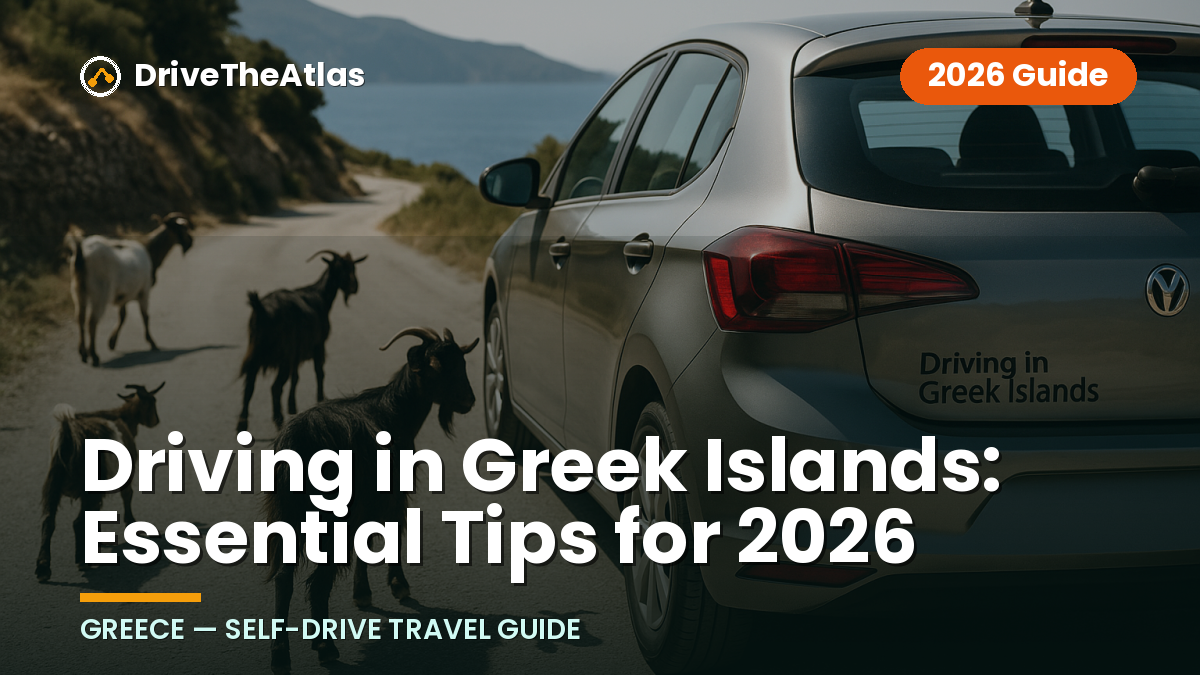
Driving in Greek islands can be one of the best ways to reach quiet beaches, hilltop villages, sunset viewpoints, and family-run tavernas that buses do not always serve well. But in 2026, it is still not a casual “just follow the GPS” experience.
Expect narrow village lanes, steep mountain roads, goats on blind corners, limited parking, and fewer fuel stations than you may be used to. This guide is a practical field manual for first-time visitors, especially renters who want freedom without unnecessary stress.
Free cancellation on most bookings · No hidden fees
Quick Answer: Is Driving In Greek Islands a Good Idea in 2026?
Yes, driving in Greek islands is a good idea if you are comfortable with slow, defensive driving and you choose the right island, route, and vehicle. It gives you excellent flexibility, especially on islands where beaches, villages, and viewpoints are spread out.
The catch is that island driving is rarely effortless. Roads can be steep, narrow, poorly lit, and shared with buses, scooters, pedestrians, delivery vans, and livestock.
Quick verdict: rent a car if you want freedom and are willing to drive patiently. Skip it if you are nervous on mountain roads, dislike tight parking, or plan to stay mostly in one town.
When Driving Makes Sense
Driving in Greek islands makes the most sense when your accommodation is outside the main town or when you want to visit remote beaches. On islands like Crete, Naxos, Kefalonia, Rhodes, Corfu, Lesvos, and Zakynthos, distances can be bigger than they look on a map.
A car is also useful if you are traveling with children, beach gear, hiking equipment, or luggage. Buses may be affordable, but they often follow limited schedules outside peak tourist routes.
Driving can be especially rewarding if you prefer early starts. Reaching a beach before the crowds arrive, or leaving a mountain village before darkness falls, can completely change the experience.
When to Skip the Car and Use Taxis or Buses
Skip the car if you are staying in a dense old town and only plan to visit nearby beaches. Places with walkable centers and strong local bus routes may not justify the parking stress.
You may also want to avoid driving in Greek islands if your itinerary depends on nightlife. Road lighting can be limited, taxis may be safer after dinner, and rural routes become harder once animals, scooters, and sharp bends are less visible.
If you are visiting a very small island, a protected island, or a destination with restricted vehicle access, taxis, boats, walking, or buses may be the better choice.
Who This Guide Is For
This guide is for travelers driving in Greek islands for the first time, including visitors from the UK, North America, Australia, and mainland Europe. It is especially useful if you plan to rent a car and explore beyond the port town.
It is also for cautious drivers who want realistic expectations. Greek island road safety is not about being fearless; it is about reading the road, allowing extra time, and knowing when to slow down.
If you are researching driving in Greece for foreigners, treat this as a practical supplement to official road rules, your rental contract, ferry schedules, and current local guidance.
What’s Different About Driving In Greek Islands vs. Mainland Greece

Driving in Greek islands feels different from driving on mainland highways or in large Greek cities. Mainland Greece has major motorways, wider regional roads, and more frequent services in many areas.
Island roads are more compressed. They often climb quickly from port level to mountain villages, then drop again toward beaches through tight bends and rougher surfaces.
The biggest difference is predictability. On an island, a short 12-mile drive can include hairpins, goats, a bus coming downhill, a village lane barely wider than your mirrors, and no fuel station for the rest of the afternoon.
Narrow Village Streets and Hairpin Turns
Many Greek island villages were not built for modern rental cars. Streets may be stone-paved, one-way without much warning, or lined with balconies, steps, scooters, and parked vehicles.
A compact car is often easier than a large SUV in these places. You may need to fold mirrors, pause for pedestrians, or reverse gently to let another vehicle pass.
Hairpin turns are common on routes between coastal resorts and inland villages. Take them wider and slower than you would on a city road, especially if the inside of the curve is steep or covered with loose gravel.
Mountain Roads, Blind Bends, and Steep Grades
Greek island mountain roads can be dramatic and beautiful, but they require attention. A route that looks simple on Google Maps may include blind bends, cliff edges, rough patches, and sudden changes in gradient.
GPS ETAs are often optimistic because they do not fully account for rental-car caution, animal stops, tour buses, photo pull-offs, or unfamiliar roads. Add buffer time, especially if you are heading to a ferry, airport, or sunset viewpoint.
Driving in Greek islands is usually safer when you treat every blind bend as occupied. A goat, scooter, parked car, or local pickup may be just beyond the curve.
Traffic Patterns in Peak Summer
In July and August, island roads can change character completely. Morning roads may feel calm, while late afternoon routes near beaches, ports, and sunset spots can become slow and crowded.
Tour buses need more space on curves and may swing wide. Scooters filter through traffic, and pedestrians often walk along roads without proper sidewalks.
If you are driving in Greek islands during peak summer, plan shorter daily routes. Heat, congestion, and parking pressure can make long scenic loops more tiring than expected.
Greek Island Road Rules and License Requirements
Before driving in Greek islands, understand the basics. Greece drives on the right-hand side of the road, overtakes on the left, and follows standard European-style road signage.
Travelers should always check current driving in Greece rules before departure. Guidance from sources such as the RAC Greece driving guide and official travel advisories is useful, but local rules and rental terms can change.
Which Side of the Road to Drive On
If you are wondering about driving in Greece left or right, the answer is right. Vehicles drive on the right-hand side, and the driver sits on the left side of most rental cars.
For travelers driving in Greek islands from UK, Australia, Ireland, or other left-side-driving countries, this is one of the biggest adjustments. Roundabouts, junctions, and narrow village exits deserve extra concentration.
A simple habit helps: before pulling away, say “keep right” out loud. It sounds basic, but it can prevent mistakes after fuel stops, viewpoints, or quiet beach car parks.
Seat Belts, Helmets, and Basic Road Rules
Wear seat belts in the car and make sure passengers do the same. If you rent a scooter or ATV, helmets are essential and may be legally required depending on the vehicle and situation.
Do not use a handheld phone while driving. Avoid alcohol before driving, especially on unfamiliar mountain roads where judgment and reaction time matter.
Speed limits, road signs, and priority rules should be followed conservatively. Even if some local drivers move faster, visitors should drive for conditions, not for social pressure.
What Documents Tourists Should Carry
Carry your valid driving license, passport or ID, rental agreement, and insurance documents. Some travelers may need an International Driving Permit depending on their license country and rental company requirements.
Check this before booking, not at the counter. Rental agencies may apply their own document rules, and ferry companies may also have requirements if you plan to move a vehicle between islands.
For driving in Greece for foreigners, the safest approach is to confirm license requirements with your rental company and official government guidance before travel.
The Biggest Hazards: Goats, Livestock, and Other Unexpected Road Obstacles
The most memorable part of driving in Greek islands is not the scenery. It is the moment a goat steps calmly into the road halfway around a blind bend.
Goats, sheep, donkeys, dogs, cats, chickens, and farm vehicles can all appear on rural island roads. Some animals are fenced in, but many roam freely or move between grazing areas.
This is not a reason to panic. It is a reason to drive as if the road is shared with unpredictable traffic.
Why Animals Are Common on Island Roads
Many islands have active farming, grazing land, and small rural communities. Roads often cut through hillsides, fields, and open scrub where animals naturally move.
Goats on Greek island roads are especially common near mountain routes, quiet beaches, and inland villages. They may stand on warm asphalt, cross in groups, or rest near bends where visibility is poor.
Do not assume an animal will move because you approach. Goats can freeze, turn back suddenly, or follow the herd in the opposite direction.
How to Drive When Goats Are on the Road
Slow down early and avoid sudden swerving. Use the brake gently, keep both hands on the wheel, and give the animals space.
If goats are blocking the road, wait. A light horn tap may help in some situations, but aggressive honking can startle animals and make them move unpredictably.
When driving in Greek islands, never speed past a single goat without checking for the rest of the herd. Where there is one animal, there are often more just out of sight.
What to Do on Roads With No Shoulder
Many rural island roads have no usable shoulder. There may be a stone wall on one side and a drop, ditch, or scrub on the other.
If an animal, pedestrian, or vehicle blocks the lane, stop where you are visible. Do not pull onto unstable edges, especially after rain or on gravel.
Use hazard lights if necessary, stay calm, and wait for a safe gap. Island driving rewards patience more than assertiveness.
Mountain Roads, Blind Corners, and Steep Climbs: How to Drive Safely
Greek island mountain roads are where confidence matters most. The goal is not to drive fast; it is to drive smoothly and leave yourself options.
Road surfaces can vary from good asphalt to patched, narrow, uneven lanes. Gravel, sand, fallen rocks, and potholes may appear after storms or on less-maintained routes.
When driving in Greek islands, assume that a road marked as “main” on a map may still feel rural by northern European or North American standards.
Use of Lower Gears and Engine Braking
On steep climbs, use a lower gear before the engine struggles. This gives the car better control and reduces constant gear hunting in small automatics.
On descents, do not ride the brakes continuously. Use lower gears and engine braking to keep speed controlled, especially on long downhill sections.
If you smell hot brakes or feel the pedal becoming less responsive, pull over safely and let the car rest. This is rare if you drive properly, but it is worth knowing.
Keeping Speed Realistic on Curves
The posted speed limit is not always the safe speed. On blind corners, rough surfaces, or roads with no barrier, go slower than the limit if conditions require it.
A useful rule is to enter a curve at a speed that allows you to stop within the distance you can see. If you cannot see around the bend, you should not assume the road is clear.
This is one of the most important habits for Greek island road safety. It protects you from animals, buses, scooters, pedestrians, and parked vehicles.
Passing, Overtaking, and Honking Etiquette
Avoid overtaking unless the road is clearly visible, wide enough, and legally safe. Passing on bends or hills is especially risky.
In some rural areas, a short horn tap before a blind bend may be used by local drivers to warn oncoming traffic. Use this lightly and sparingly; it is not a license to speed.
If a local driver wants to go faster, let them pass when safe. Pull into a lay-by or straight section rather than trying to match their pace.
Fuel, Range, and Why “Sparse Gas Stations” Matter More Than You Think
Fuel planning matters when driving in Greek islands because stations can be unevenly distributed. Large towns and port areas usually have options, but remote beaches and mountain routes may not.
Some smaller islands have limited station hours, fewer pumps, or long gaps between services. Do not assume you can refuel near every beach or village.
The simple rule: fill up before scenic drives, not after the fuel light comes on.
Plan Fuel Stops Before Leaving Towns
Check fuel locations before leaving the main town, especially if you are heading inland or to the far side of the island. Save the locations offline in case mobile signal drops.
Greek island fuel stations are often clustered around ports, towns, and main roads. Mountain routes may have none for long stretches.
If your itinerary includes a sunset viewpoint, remote cove, or late dinner in a village, refuel earlier in the day. It is much easier than searching for an open station at night.
Never Let the Tank Run Too Low
Do not let the tank fall below a comfortable buffer. On unfamiliar islands, I treat half a tank as the point to start thinking about fuel, not empty.
This matters because steep roads increase fuel use, especially in small engines with passengers and luggage. Air conditioning in summer also adds load.
When driving in Greek islands, a fuel buffer gives you freedom to detour, avoid a closed road, or return by a longer but safer route.
Best Car Types for Fuel Efficiency vs Hill Performance
The ideal car balances fuel efficiency with enough power for hills. A tiny economy car may be cheap to run, but it can feel strained on steep climbs with four adults and bags.
A large SUV may offer power, but it can be awkward in villages and harder to park. For many travelers, a compact hatchback with a reasonably strong engine is the sweet spot.
| Vehicle Type | Best For | Watch Out For |
|---|---|---|
| Mini/economy car | Couples, short trips, easy parking | Weak hill performance with luggage |
| Compact hatchback | Most island itineraries | Book early in peak season |
| Small SUV/crossover | Rougher roads, families, hills | Wider body in villages |
| Automatic | Nervous drivers, left-side-driving visitors | Limited supply on some islands |
| Manual | Lower cost, better availability | Harder if you dislike hill starts |
Free cancellation on most bookings · No hidden fees
Choosing the Right Rental Car for Greek Island Roads
The right vehicle can make driving in Greek islands feel far less stressful. Choose for the actual roads, not just the headline daily rate.
For most visitors, the best rental is small enough for villages, strong enough for hills, and easy to park. If you only remember one Greek island car rental tip, make it this: bigger is not always better.
You can compare rental options through DiscoverCars, where the homepage emphasizes “Best Car Rental Deals with Free Cancellation, Compare & Save!” It also offers access to member-only deals and lets users manage bookings in one place, which is useful if your ferry or flight timing changes.
Compact vs. SUV vs. Automatic
A compact car is usually the safest default for island roads. It fits more easily through villages, uses less fuel, and handles tight parking better.
A small SUV or crossover can help if you are staying in the hills, traveling with family, or using rougher access roads. Just remember that width matters more than ground clearance in many old villages.
Automatic cars are helpful for drivers who are nervous about hill starts or adjusting to right-hand traffic. However, availability may be lower, so book early if automatic transmission is important.
Why Smaller Cars Can Be Better in Villages
Village roads can be extremely tight. A smaller car gives you more room to pass scooters, avoid stone walls, and squeeze into realistic parking spaces.
You will also feel less pressure when reversing or meeting traffic on narrow lanes. That comfort matters, especially if you are driving in Greek islands for the first time.
Small cars are not perfect for every route, but they reduce stress in the places where most rental damage happens: car parks, village corners, hotel entrances, and ferry queues.
When Extra Power Helps
Extra power helps on steep climbs, especially with passengers, luggage, and air conditioning. It also makes uphill starts easier when a road pauses at a junction or hairpin.
This does not mean you need a large vehicle. A compact car with a slightly stronger engine is often better than the smallest category available.
If your route includes Greek island mountain roads, read the vehicle details carefully before booking. Engine size, transmission, and luggage capacity can matter more than the photo.
Ferry and Pickup Logistics for Island Road Trips
Ferry logistics can complicate driving in Greek islands. The question is whether to rent on each island or take a car on the ferry.
In many cases, renting on arrival is simpler. It avoids ferry vehicle fees, rental restrictions, loading stress, and the possibility that your rental agreement does not permit inter-island travel.
Always check your rental terms before taking any car onto a ferry. Do not assume it is allowed.
Renting on Arrival vs. Ferrying a Car
Renting on arrival works well if you are visiting one island or spending several days there. You can pick up near the airport, port, or town and avoid transporting the vehicle.
Ferrying a car may make sense for longer trips across connected islands, but only if the rental company permits it and the ferry schedule is reliable for your plan.
For first-time visitors, the renter-friendly option is usually separate rentals on each island. It reduces risk if a ferry is delayed or canceled.
What to Check Before Boarding a Ferry
Check ferry times, port location, vehicle boarding rules, and arrival buffer. Island ports can be congested, especially in summer and on changeover days.
Arrive early if you are boarding with a vehicle. Ferry staff may direct you quickly, and the loading process can feel intense if you are unfamiliar with tight ramps and close parking.
Confirm whether your insurance applies on ferries and whether roadside support continues on the next island. These details are in the rental terms, not in your travel wish list.
Drop-Off and One-Way Considerations
One-way rentals may be possible in some places but are not guaranteed everywhere. They can also involve additional conditions, so confirm before booking.
If you are dropping off at a port before a ferry, leave extra time for fuel, photos of the vehicle, paperwork, and walking to the terminal. Ports are not always laid out like airports.
Avoid planning a car return minutes before departure. A delayed fuel stop or parking queue can create unnecessary stress.
Parking, Town Centers, and Summer Congestion
Parking is often the least glamorous challenge of driving in Greek islands. Even confident drivers can find old-town parking more stressful than mountain roads.
Popular villages, beach areas, and port towns may fill up quickly. In peak season, legal parking can be a long walk from the place you actually want to visit.
Think of parking as part of the route plan, not something to solve at the end.
Tight Parking in Popular Villages
Arrive early for popular villages and beaches. Morning parking is usually easier, cooler, and less chaotic.
Avoid driving deep into old centers unless your accommodation confirms there is accessible parking. Streets may narrow suddenly, and turning around can be difficult.
If you see a legal lot outside the center, take it. Walking ten minutes is often easier than squeezing through traffic and hunting for a space near the square.
Blue Zones, Beach Parking, and Illegal Spots
Parking systems vary by island and town. Some areas use marked paid zones, color-coded spaces, signs in Greek and English, or informal beach lots.
Do not copy local parking behavior unless you understand the rules. A spot that looks normal may block access, sit on private land, or cause problems for buses and emergency vehicles.
At beaches, avoid parking on soft sand, dry grass, or unstable edges. Besides the risk of getting stuck, dry vegetation can be a fire hazard in summer.
How to Avoid Fines and Towing Stress
Read signs carefully and look for restrictions near ports, bus stops, taxi ranks, hotel entrances, and narrow streets. If you are unsure, ask your accommodation where visitors should park.
Take a photo of your parked car and nearby signs. This helps you find the car later and gives you a record if a misunderstanding occurs.
When driving in Greek islands, paying for a proper lot can be the cheapest stress reduction of the day.
A 2026 Greek Island Driving Checklist
Use this checklist before and during your trip. It is designed for 2026 travel planning, but you should still confirm current local rules, ferry schedules, and rental terms before departure.
A good checklist turns island driving from guesswork into routine.
Before You Pick Up the Car
- Confirm your license is accepted and check whether you need an International Driving Permit.
- Review the rental company’s fuel policy, deposit, insurance, ferry rules, and damage process.
- Choose a vehicle size that matches village roads, hills, luggage, and parking.
- Check ferry times before selecting pickup and drop-off times.
- Download offline maps for the island.
- Save fuel stations, accommodation, port, and emergency contacts.
What to Pack in the Vehicle
- Driving license, passport or ID, rental agreement, and insurance details.
- Phone charger and mount.
- Water, especially in summer.
- Sunglasses for glare on coastal roads.
- Light jacket if driving mountain routes in shoulder season.
- Small cash reserve for parking or fuel stations that may not accept your preferred card.
- Motion-sickness supplies if passengers dislike winding roads.
Final Safety Checks Before Each Day Trip
Before every drive, check fuel, route, daylight, and parking. These four things prevent most avoidable island-driving stress.
Walk around the car for obvious damage, low tires, or blocked mirrors. Adjust the seat and mirrors before leaving, not while rolling through town.
If you are driving in Greek islands on a long day trip, tell someone your rough route or share your location. It is a simple precaution on remote roads.
Best Time of Day to Drive on Greek Islands
The best time to drive is usually early morning or late afternoon before dark. Roads are cooler, parking is easier, and the light is better.
Midday can be hot, bright, and crowded near beaches. After dark, rural roads become more demanding because animals, pedestrians, and sharp bends are harder to see.
For nervous visitors, timing is one of the easiest ways to improve Greek island road safety.
Avoiding Midday Heat and Tour-Bus Traffic
Midday heat can make drivers tired and impatient. It also puts more strain on small rental cars climbing hills with air conditioning running.
Tour buses often move between beaches, villages, and ports during the day. Give them space, especially on bends and village approaches.
If you plan a mountain route, start early and return before the late-afternoon rush. This keeps the drive calmer and leaves time for unexpected stops.
Driving After Dark: When to Avoid It
Avoid rural night driving if you are new to the island, tired, or heading through mountains. Street lighting can disappear quickly outside towns.
Animals may be harder to spot, scooters may have limited lighting, and road edges may not be clearly marked. Even familiar roads can feel different after sunset.
If you want dinner in a remote village, consider going before dark, driving back carefully, or using a taxi if available.
Short Hops vs. Long Scenic Routes
Short hops are usually better for first-time renters. Choose one beach, one village, or one scenic drive per outing rather than linking too many stops.
Long scenic routes are rewarding, but they require more fuel planning, daylight, and concentration. Add generous time for slow roads and unexpected delays.
When driving in Greek islands, the best itinerary is not the one with the most pins. It is the one you can enjoy without rushing.
What to Do If You Meet a Goat, a Bus, or a Local Driver on a Single-Lane Road
Sooner or later, you may meet something awkward on a road that feels too narrow: a goat herd, a bus, a delivery truck, or a local driver who knows every bend.
This is the moment to stay calm. Island roads work because drivers cooperate, not because every lane is perfectly wide.
The safest driver is the one who slows early, communicates clearly, and avoids sudden moves.
Yielding and Reversing Safely
If the oncoming vehicle has less room, yield when safe. Larger vehicles, uphill traffic, and vehicles already committed to a narrow section may need priority in practice.
If you must reverse, do it slowly. Use mirrors, ask a passenger to guide you if possible, and stop if you are unsure about the edge.
Do not let pressure from another driver make you rush. A small delay is better than scraping a wall, dropping a wheel off the road, or startling an animal.
Using Pull-Offs and Passing Places
Look ahead for wider patches, driveways, lay-bys, and village entrances. These are informal passing places on many island roads.
If you see a bus or truck approaching, stop before the narrowest section rather than meeting in the middle. This makes the maneuver easier for everyone.
On mountain roads, never stop in a blind bend unless you have no alternative. Try to position the car where approaching traffic can see you.
Staying Calm in Tight Encounters
Use simple signals: slow down, make eye contact when possible, and gesture politely if yielding. Avoid aggressive honking or sudden acceleration.
If goats are involved, wait for the herd to clear completely. If a bus is involved, assume it needs more turning room than you think.
Driving in Greek islands becomes much less intimidating when you accept that slow moments are normal. The road is not delaying your trip; it is part of the island.
Free cancellation on most bookings · No hidden fees
FAQ
Is Driving on the Greek Islands Easy?
Not always. Driving in Greek islands is manageable for careful visitors, but many roads are narrow, steep, winding, and full of blind bends.
It is easiest if you drive slowly, avoid rural roads after dark, choose a compact car, and plan fuel and parking in advance. Nervous drivers should start with short daytime trips before attempting mountain routes.
Which Greek Islands Don’t Allow Cars?
Some small, protected, or highly compact Greek islands restrict cars, limit visitor vehicles, or make cars impractical. Examples can change depending on local rules, ferry access, and the type of vehicle.
Before traveling, check the official island guidance, ferry rules, accommodation advice, and rental terms. Do not assume every island is suitable for cars just because it has roads.
Is Renting a Car in Greece a Good Idea?
Yes, renting a car in Greece can be a very good idea if you want flexibility, remote beaches, mountain villages, and scenic viewpoints. It is especially useful on larger islands where buses do not reach every place conveniently.
The best fit depends on the island, your route, and your comfort level. Compare vehicle types, cancellation flexibility, and pickup locations before booking.
What to Know Before Driving in Greece?
Know that Greece drives on the right, standard road safety rules apply, and tourists should carry the correct license and rental documents. Some visitors may need an International Driving Permit, so check before departure.
Also prepare for mountain roads, goats and livestock, tight parking, sparse fuel stations, scooters, buses, and optimistic GPS timings. For driving in Greece rules, confirm current requirements with official sources and your rental company before you go.
Conclusion: Driving In Greek Islands Is Worth It If You Plan Like a Local
Driving in Greek islands in 2026 can be deeply rewarding, but it works best when you respect the roads. The real challenges are not complicated: narrow villages, mountain bends, goats, buses, limited fuel stops, and parking pressure.
Choose a sensible car, start early, keep fuel in the tank, avoid rushing, and treat every blind corner as shared space. If you are renting, compare options before you commit, prioritize free cancellation where available, and make sure the vehicle matches your island route.
For a practical starting point, you can compare Greek rental cars with DiscoverCars and review vehicle type, pricing, and booking flexibility before your trip. Then drive slowly, leave extra time, and enjoy the parts of the islands that buses rarely reach.
Related Reading
- Renting a Car in Crete: Honest 2026 Guide
- Driving the Amalfi Coast: Honest 2026 Guide
- Driving in Iceland 2026: Road Rules, Speed Limits, Tolls, and Fines