
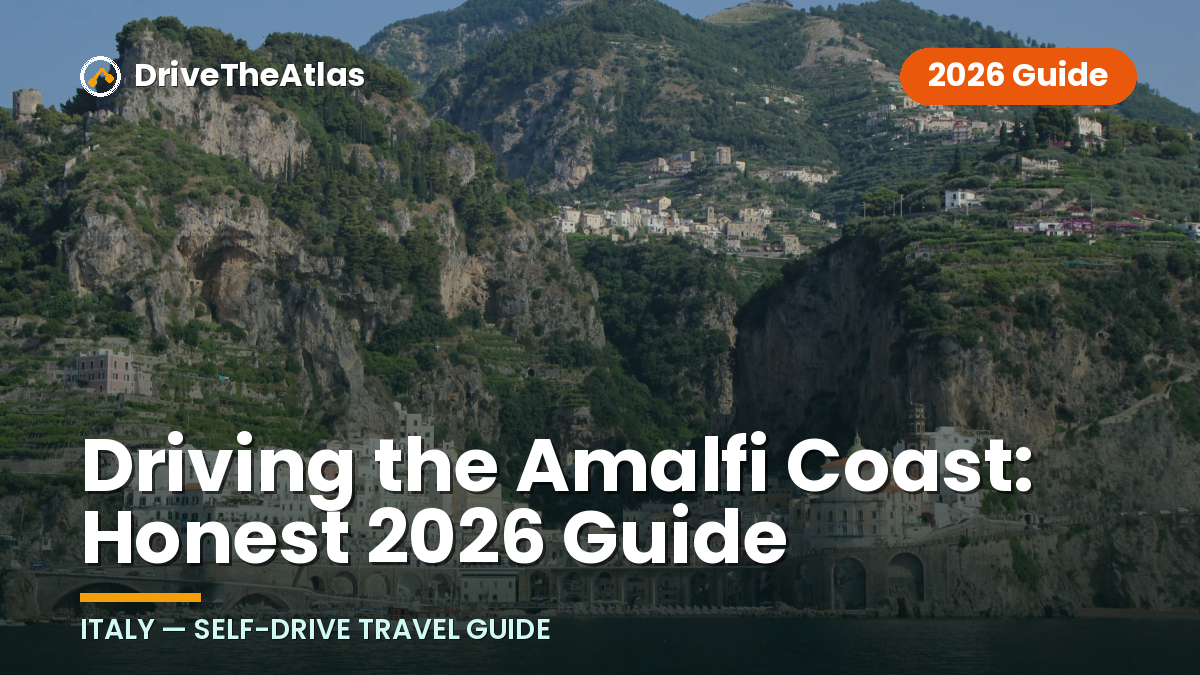
If you’re wondering whether driving the Amalfi Coast is a dream road trip or a stressful mistake, the honest answer is: it depends heavily on your confidence, timing, itinerary, and tolerance for parking headaches.
The coastline is spectacular, but the driving experience is not effortless. The SS163 Amalfi Coast road is narrow, curvy, busy, and often unforgiving for larger rental cars. For some travelers, a car adds freedom. For others, it becomes the most expensive and stressful part of the trip.
Free cancellation on most bookings · No hidden fees
Quick verdict: should you drive the Amalfi Coast in 2026?
The short answer for first-time visitors
For most first-time visitors staying in Positano, Amalfi, or Ravello, driving the Amalfi Coast is not the easiest way to enjoy the area. Ferries, private transfers, buses, and walking between town centers often create a smoother experience.
That said, self-driving can make sense if you’re visiting outside peak season, staying somewhere with guaranteed parking, or combining the coast with Pompeii, Naples, Puglia, Cilento, or inland Campania.
Here’s the practical verdict:
| Traveler type | Best choice |
|---|---|
| First-time visitor staying in Positano or Amalfi | Usually skip the car |
| Confident driver visiting in shoulder season | Car can work |
| Family with luggage and rural accommodation | Car may be useful |
| Nervous driver or oversized vehicle renter | Avoid self-driving |
| Road trip traveler continuing through Italy | Rent strategically, not necessarily on the coast |
The big question is not “Can you drive it?” You can. The better question is whether the car improves your trip enough to justify the traffic, road conditions, and parking.
Who should drive vs. who should skip it
You may enjoy driving the Amalfi Coast if you:
- Are comfortable with narrow roads and close passing traffic
- Can drive defensively without panicking
- Book accommodation with confirmed parking
- Travel early in the morning or outside peak summer
- Want flexibility for villages, viewpoints, and inland detours
- Are continuing to places poorly served by ferries or trains
You should probably skip it if you:
- Are only staying in Positano or Amalfi town
- Plan to arrive midday in high season
- Are uncomfortable with tight corners or scooters
- Need an automatic but can only find a larger vehicle
- Expect easy street parking
- Want a relaxed, low-effort vacation
This is where many romantic Amalfi Coast road trip guides understate the reality. The views are real, but so are the blind curves, traffic queues, and parking searches.
Best alternatives if you don’t self-drive
If you decide against driving the Amalfi Coast, you still have good options:
- Ferries: Often the most scenic and relaxed way to travel between coastal towns when operating.
- Private transfers: Expensive compared with public transport, but useful with luggage.
- SITA buses: Budget-friendly, though crowded and slow in busy periods.
- Train plus ferry: A strong option from Naples or Rome via Salerno or Sorrento.
- Day tours: Useful if you want someone else to handle logistics.
- Hybrid travel: Rent a car for inland Italy, then use ferries or transfers along the coast.
For many international travelers, especially Americans used to wider roads and abundant parking, the hybrid approach is the sweet spot.
What driving the Amalfi Coast is actually like
Road width, curves, and cliffside sections
The main coastal road, SS163 Amalfi Coast, is one of Italy’s most famous scenic drives. It hugs cliffs, curves around villages, and offers dramatic sea views. It is also narrow, busy, and lined with walls, parked scooters, buses, pedestrians, and tight bends.
When people ask how difficult is it to drive the Amalfi Coast, the answer is usually: not technically impossible, but mentally tiring. You need to stay focused almost constantly.
Expect:
- Hairpin turns and blind corners
- Limited shoulder space
- Tight passing with buses and vans
- Frequent braking
- Pedestrians near town centers
- Scooters filtering through traffic
- Few places to pull over spontaneously
If you are used to wide North American roads, driving the Amalfi Coast can feel more compressed than dangerous. The main challenge is space management, not speed.
Traffic patterns in high season vs. shoulder season
Traffic changes the entire experience. In quieter months, the drive can feel scenic and manageable. In peak summer, especially weekends and midday, it can feel like one long negotiation with buses, rental cars, taxis, scooters, and delivery vehicles.
The best time to drive Amalfi Coast roads is generally early morning, before day-trippers and tour traffic build up. Late afternoon can also be better in some stretches, but town approaches may still be congested.
Shoulder season usually means:
- Easier movement between towns
- Less pressure from vehicles behind you
- Better odds of finding parking
- More enjoyable photo stops
High season often means:
- Slow travel times
- Full garages
- More buses on tight curves
- Increased stress in town centers
This is why driving the Amalfi Coast in April or October can feel completely different from doing it on a summer weekend.
Why buses and scooters change the experience
Buses are part of daily life on the coast, and they are not the enemy. But they do shape the driving experience. On tight curves, larger vehicles sometimes need extra room, and traffic may pause while drivers coordinate space.
Scooters also require attention. They may pass on either side, squeeze through gaps, or appear quickly around bends. Local riders are used to the rhythm of the road; visitors often are not.
If you decide on driving the Amalfi Coast, your job is not to rush. Stay predictable, keep right where safe, avoid sudden moves, and let faster local traffic pass when there is a legal and safe opportunity.
How long the Amalfi Coast drive takes
Sorrento to Positano
On a map, Sorrento to Positano looks short. In reality, it can take much longer than expected because the route includes curves, traffic, and bottlenecks near town entrances.
Map apps can be useful for an Amalfi Coast drive map, but they often underestimate the total experience. They may not fully account for:
- Slow buses on narrow sections
- Parking searches
- Photo stops
- Town congestion
- Seasonal restrictions
- Delays caused by roadworks or local access rules
If you are driving the Amalfi Coast from Sorrento to Positano, do not plan a tight schedule. Add buffer time, especially if you have lunch reservations, ferry connections, or hotel check-in windows.
Positano to Amalfi
Positano to Amalfi is one of the most famous stretches of SS163. It is also one of the sections where travelers most often realize that distance on the map means very little.
The route is beautiful, but you may not get to enjoy the view much if you are the driver. The passenger gets the postcard experience; the driver gets the curves, mirrors, scooters, and oncoming buses.
For a relaxed day, avoid treating driving the Amalfi Coast like a checklist. Choose fewer stops and build your day around one or two towns instead of trying to see everything from Sorrento to Ravello and back.
Amalfi to Ravello and return routes
Ravello sits above the coast, so reaching it involves climbing inland from Amalfi. The road is scenic, but it can be tight and slow, especially near town centers and parking areas.
Many travelers underestimate the return journey. A route that looks simple on a screen may feel tiring after a full day of heat, crowds, and narrow-road concentration.
If your plan involves driving the Amalfi Coast plus Ravello in one day, start early and confirm parking options before you go. Ravello is often easier to enjoy when you are not arriving at the busiest hour.
Parking on the Amalfi Coast: the biggest hidden cost
Why parking is scarce and expensive
Amalfi Coast parking is one of the main reasons I hesitate to recommend a rental car for first-time visitors. The towns are built into cliffs and valleys, not designed around large numbers of private vehicles.
Parking is limited, demand is high, and garages can fill during busy periods. Street parking exists in some areas, but it is rarely something you should rely on casually.
The hidden cost is not only money. It is time, stress, and itinerary control. Driving the Amalfi Coast often means planning your entire day around where you can legally leave the car.
Before booking a rental, ask yourself:
- Does my hotel include or offer parking?
- Do I need to reserve parking in advance?
- Am I willing to pay garage rates if street parking is unavailable?
- Can I arrive early enough to avoid full lots?
- What happens if parking near my target town is full?
If those questions sound annoying now, they will feel worse after navigating a cliff road with luggage in the trunk.
Where parking is easiest by town
Parking difficulty varies by town, season, and time of day. In general, smaller villages may be easier than Positano, but “easier” does not always mean easy.
| Town/Area | Practical parking reality |
|---|---|
| Positano | Often one of the hardest and most expensive-feeling places to arrive by car |
| Amalfi | More central options than Positano, but demand is high |
| Ravello | More manageable if arriving early, but still limited |
| Praiano | Can be easier than Positano, depending on accommodation |
| Sorrento | Better as a base with garages, though not technically on the Amalfi Coast |
| Salerno | Often better for train/ferry connections than coastal self-driving |
For many travelers, driving the Amalfi Coast works better when staying outside the most congested towns and using ferries or buses for certain day trips.
Street parking, garages, and hotel parking
Street parking should be treated as a bonus, not a plan. Regulations vary, spaces may be restricted, and signs can be confusing if you are unfamiliar with Italian parking rules.
Garages are usually more reliable, but they can be limited and may require advance planning. Hotel parking is often the most important filter when choosing where to stay with a car.
Before confirming accommodation, ask:
- Is parking on-site or off-site?
- Is it guaranteed or subject to availability?
- Do I need to reserve it?
- Can I access the hotel by car without entering a restricted zone?
- Are there size limits for vehicles?
This is one reason driving the Amalfi Coast is not just a rental decision. It is an accommodation decision, an arrival-time decision, and sometimes a town-choice decision.
Amalfi Coast driving restrictions 2026
Alternating license plate rules
Amalfi Coast driving restrictions 2026 are one of the most important things to verify before your trip. In recent years, local authorities have used traffic-control measures at certain times, including systems based on license plate numbers.
Because these rules can change by season, road section, vehicle type, and local ordinance, do not rely only on old forum posts or outdated travel blogs. Before driving the Amalfi Coast, check official municipal or regional sources, your accommodation, and your rental company for current rules.
If you see discussions about alternating license plate access, confirm:
- Which dates apply
- Which roads are affected
- Whether rental cars are included
- Whether foreign plates are treated differently
- What exemptions exist, if any
- How enforcement works
A practical tip: ask your hotel to confirm the current access rules in writing before arrival. Local accommodations usually track changes because guests ask constantly.
Seasonal traffic restrictions to check before you go
Seasonal restrictions may apply during high-demand periods, holidays, weekends, or specific traffic-control windows. These rules are designed to manage congestion, not to surprise tourists, but they can disrupt plans if you ignore them.
Before driving the Amalfi Coast, verify:
- Current SS163 access rules
- Any temporary roadworks
- Local holiday closures or event traffic
- Bus lane or loading restrictions
- Ferry schedules if using a hybrid plan
- Parking garage access times
For route planning, use your map app as a starting point, not the final authority. An Amalfi Coast drive map can show the road, but it may not fully explain local restrictions or temporary access rules.
ZTL zones and town-center access
ZTL zones are restricted traffic areas common in Italian towns and cities. They are usually designed to protect historic centers and reduce traffic. Entering without authorization can lead to fines, often processed later through the rental company.
On the coast, the details vary by town and can change. Do not assume that because a road appears open on your navigation app, you are allowed to drive through it.
Before driving the Amalfi Coast, read signs carefully and confirm town-center access with your hotel or garage. If you are new to the concept, see our internal guide to [Italy ZTL zones](/italy-ztl-zones/) before renting a car.
The safest habit is simple: do not drive into historic centers unless you know you are permitted and have a specific parking destination.
Best car to rent for the Amalfi Coast
Why small cars are easier
The best rental car for driving the Amalfi Coast is the smallest vehicle that comfortably fits your passengers and luggage. A compact car is easier to place on narrow roads, easier to maneuver in garages, and less stressful on tight town approaches.
This is not the place to upgrade just because a larger vehicle seems more comfortable. Bigger cars can make every curve, parking garage ramp, and bus pass feel more difficult.
Good priorities for an Amalfi Coast rental:
- Small exterior size
- Good visibility
- Comfortable luggage fit
- Familiar transmission
- Parking sensors or camera if available
- Clear insurance and cancellation terms
If you are traveling with large suitcases, consider reducing luggage before choosing a bigger car. On the Amalfi Coast, less luggage can genuinely mean a better driving experience.
Manual vs automatic considerations
Manual cars are common in Italy, but many international travelers prefer automatics. If you are not comfortable driving manual on hills and tight curves, do not use the Amalfi Coast as your practice course.
An automatic may cost more or have fewer options, but confidence matters. Driving the Amalfi Coast requires attention, and you do not want to be thinking about clutch control while negotiating a blind bend with a bus approaching.
If you need automatic, book early and compare carefully. Also check whether the car class shown is guaranteed or only an example, and review cancellation terms in case your plans change.
What to avoid when booking
Avoid booking:
- Oversized SUVs
- Large vans unless absolutely necessary
- Cars with more luggage space than you need
- Unfamiliar manual transmissions if you are rusty
- Tight pickup windows after a long international flight
- Rentals without reviewing parking plans first
If you are comparing options, tools like DiscoverCars can help you review Italy rental availability, compare vehicle sizes, look for free cancellation where offered, and manage bookings in one place. I’d use it especially to compare pickup locations, automatic availability, and the smallest suitable car rather than simply choosing the cheapest listing.
Free cancellation on most bookings · No hidden fees
When driving the Amalfi Coast is worth it
You want flexibility for side trips
Driving the Amalfi Coast can be worth it when your trip is not only about Positano and Amalfi. A car gives you more flexibility for viewpoints, lesser-known villages, inland restaurants, and spontaneous detours.
It can also help if you are staying in a villa, agriturismo, or hillside property away from ferry docks and bus stops. In those cases, relying entirely on public transport can be awkward.
A car is most useful when your itinerary includes:
- Multiple inland stops
- Accommodation outside town centers
- Early morning starts
- Scenic viewpoints
- Luggage transfers between regions
- Places with limited public transport
The key is matching the car to the route, not forcing a car into a town-based itinerary.
You are continuing beyond the coast
If the Amalfi Coast is part of a larger Italy route, renting a car can make more sense. For example, you may want to visit Pompeii, Paestum, Cilento, Basilicata, or Puglia before or after the coast.
In that case, consider whether you need the car every day. Sometimes the smartest plan is to rent after leaving Naples, use the car for inland travel, park at accommodation with confirmed space, then avoid using it for coastal town-hopping.
This is where driving the Amalfi Coast becomes one part of a broader road trip rather than the entire strategy.
You’re traveling off-season or early in the day
Timing matters more than many travelers realize. Off-season and early-morning drives are usually calmer, with fewer tour buses and less competition for parking.
The best time to drive Amalfi Coast roads is often before the main day-trip rush. If you want the scenic experience, leave early, choose one main destination, and avoid midday arrivals in the busiest towns.
In quieter conditions, driving the Amalfi Coast can feel rewarding rather than draining. The same route in peak traffic can feel like a completely different trip.
When you should not drive the Amalfi Coast
First-time drivers in Italy
If it is your first time driving in Italy, the Amalfi Coast is not the easiest introduction. Italian driving is manageable with preparation, but this region adds narrow lanes, cliffs, buses, scooters, tourists, and limited parking.
For Americans and other visitors used to wider roads, driving the Amalfi Coast can feel intense. It is not about being a bad driver. It is about whether this is how you want to spend your vacation energy.
If you are nervous, choose trains, ferries, and transfers. You can still have an excellent trip without self-driving.
Peak summer weekends and midday arrivals
Peak summer weekends are the time I would be most cautious about renting a car for the coast. Midday arrivals are especially frustrating because many garages are already busy, town centers are crowded, and roads are moving slowly.
If your flight lands in Naples late morning and your plan is to immediately collect a car and drive to Positano, think carefully. Fatigue plus unfamiliar roads plus traffic is not a great combination.
In these conditions, driving the Amalfi Coast may technically work, but it is unlikely to feel relaxing.
Travelers staying only in Positano or Amalfi
If you are staying only in Positano or Amalfi and plan to spend your time walking, eating, beach-hopping, and taking ferries, a car often adds little value.
You may pay to rent it, pay to park it, worry about restrictions, and then barely use it. That is usually not a good trade.
For a town-based trip, the better plan is often:
- Train to Naples or Salerno
- Ferry or transfer to your base
- Ferries between coastal towns
- Bus or taxi to Ravello
- Private transfer back if needed
In this scenario, driving the Amalfi Coast is usually less convenient than it sounds.
How to reduce stress if you decide to drive
Start early and avoid peak hours
If you choose driving the Amalfi Coast, start early. This one decision can make the biggest difference.
Aim to be on the road before the heaviest day-trip traffic builds. Avoid tight lunch deadlines in another town, and do not assume you can pull over anywhere for photos.
Practical driving habits:
- Use turnouts only where safe and legal
- Let local traffic pass when possible
- Avoid sudden stops for views
- Keep both hands focused on the road
- Plan your parking before you arrive
- Do not overfill the itinerary
The driver may not get the same visual experience as passengers, so build in real stops rather than sightseeing while driving.
Book parking and accommodations in advance
For a self-drive trip, accommodation with reliable parking is not a luxury detail. It is central to the plan.
Before booking, message the property and ask direct questions about parking access, availability, reservations, and vehicle size. If they mention public parking nearby, ask how far it is and whether it commonly fills.
When driving the Amalfi Coast, your hotel choice can determine whether the car feels useful or miserable. A beautiful hotel with no practical parking plan may create daily stress.
Use ferries or buses for one-way stretches
You do not have to drive every segment. A hybrid approach often works better.
For example, you could:
- Drive to your accommodation and leave the car parked
- Take ferries between Positano, Amalfi, and Salerno
- Use a bus or taxi for Ravello
- Drive only early in the morning for scenic sections
- Avoid returning on the same congested route at peak time
This approach keeps the flexibility of a rental car while reducing the most frustrating parts of driving the Amalfi Coast.
DiscoverCars: a smarter way to compare Italy rental options
Why comparison shopping matters
Rental choice matters more here than in many destinations. For driving the Amalfi Coast, the difference between a compact car and a bulky SUV can affect your stress level every day.
Comparison shopping helps you evaluate pickup locations, transmission options, cancellation terms, and vehicle size before committing. It is also useful if you are deciding whether to pick up in Naples, Salerno, Sorrento, or another mainland Italy location.
DiscoverCars’ official homepage highlights “Best Car Rental Deals with Free Cancellation, Compare & Save!” and includes features such as member-only deals, multiple languages and currencies, booking management, and a help center. I would not treat any platform as a substitute for reading the rental conditions carefully, but comparison tools are helpful for narrowing the options.
What travelers should look for in a booking
When booking a car for the Amalfi Coast, look beyond the headline price. Focus on practical fit.
Review:
- Car size and luggage capacity
- Manual vs automatic transmission
- Pickup and drop-off location
- Cancellation policy
- Fuel policy
- Driver requirements
- Insurance and deposit conditions
- Customer support and booking management options
If you compare through DiscoverCars, use it as a decision tool: find the smallest suitable vehicle, check whether free cancellation is available on the option you choose, and keep your booking details manageable in one place.
How affiliate bookings fit this guide
This guide may earn a commission if you book through the affiliate link above, at no extra cost to you. That does not change the recommendation: many travelers should not rent a car for the coast itself.
The point is to help you decide honestly. If driving the Amalfi Coast fits your itinerary, compare carefully and choose the most practical car. If it does not fit, skip the rental and spend the money on ferries, transfers, or a better-located hotel.
Sample itineraries: drive vs. don’t drive
1-day scenic drive from Sorrento
This is the classic Amalfi Coast road trip plan, but it needs restraint.
A realistic self-drive day might look like:
- Start early from Sorrento
- Drive toward Positano
- Stop only where parking is planned or clearly available
- Continue to Amalfi
- Choose either Ravello or a relaxed lunch, not both if traffic is heavy
- Return before late-day fatigue sets in
This version of driving the Amalfi Coast can work for confident drivers who understand that the goal is not to stop everywhere. The less you cram in, the better the day feels.
If you want lots of photo stops and wine at lunch, consider hiring a driver instead.
2-3 day coast base with no car
For many first-time visitors, this is the better plan.
Example no-car itinerary:
- Arrive by ferry or private transfer
- Stay in Positano, Amalfi, or Salerno
- Use ferries for coastal town-hopping
- Visit Ravello by bus, taxi, or transfer
- Spend evenings walking instead of retrieving a car
- Depart by ferry, train, or arranged transfer
This approach removes the biggest headaches of driving the Amalfi Coast while preserving the best parts: views, villages, food, water, and atmosphere.
It is especially good for couples, honeymooners, solo travelers, and anyone staying in a central hotel without parking.
Hybrid plan: car for Naples/Pompeii, ferry for the coast
The hybrid plan is often the smartest option for international travelers.
Example:
- Arrive in Naples
- Visit Pompeii or Herculaneum by train, tour, or rental car depending on luggage
- Rent a car for inland Campania or onward travel
- Stay somewhere with confirmed parking
- Use ferries or local transport for the tight coastal towns
- Return the car before spending car-free nights in Positano or Amalfi
This plan answers the question “Is driving the Amalfi Coast worth it?” with nuance. The car may be worth it for the region, but not for every day on the coastal road.
Final recommendation: the honest answer
Best choice by traveler type
Here is the clearest way to decide:
| If you are… | Recommendation |
|---|---|
| A nervous driver | Do not self-drive the coast |
| Staying only in Positano | Skip the car |
| Visiting in peak summer | Avoid driving if possible |
| Staying at a hotel with parking | Car can work |
| Traveling off-season | Self-driving is more reasonable |
| Continuing to rural Italy | Rent, but plan carefully |
| Carrying lots of luggage | Consider transfer or strategic rental |
| Confident with narrow roads | Drive early and choose a small car |
My honest view: driving the Amalfi Coast is worth it only when the car solves more problems than it creates. For many first-time visitors, it does the opposite.
Myth vs reality recap
| Myth | Reality |
|---|---|
| “It’s the ultimate easy scenic drive.” | It is scenic, but narrow, slow, and demanding. |
| “You need a car to see the Amalfi Coast.” | Many travelers do better with ferries and transfers. |
| “Parking will work out.” | Parking can shape the entire itinerary. |
| “Map times are reliable.” | Traffic, stops, and garages often add major delays. |
| “A bigger car is more comfortable.” | A smaller car is usually better on SS163. |
The road itself is not something to fear, but it is something to respect. Driving the Amalfi Coast rewards preparation, patience, and realistic expectations.
Simple decision checklist
Choose self-driving if most of these are true:
- You are a confident driver
- You will rent a small car
- You have confirmed parking
- You are traveling outside the worst congestion
- You want side trips beyond ferry towns
- You are comfortable checking current rules before travel
Skip self-driving if most of these are true:
- You are staying centrally in Positano or Amalfi
- You are visiting in peak summer
- You dislike tight roads
- You do not have parking arranged
- You want a low-stress vacation
- You mainly want beaches, restaurants, and town-hopping
Final answer: driving the Amalfi Coast can be memorable, but it is not automatically the best choice. For a true road trip, rent small, start early, verify restrictions, and book parking. For a relaxed first visit, go car-free or hybrid and let ferries, transfers, and local transport do the hard work.
Free cancellation on most bookings · No hidden fees
FAQ
How difficult is it to drive on the Amalfi Coast?
It is manageable for confident drivers, but it is more stressful than a typical scenic drive. The road is narrow, curvy, and busy, with buses, scooters, pedestrians, and limited passing space.
The hardest parts are not high speeds or extreme danger. They are tight road width, constant attention, traffic, and parking. In high season, driving the Amalfi Coast can feel tiring even for experienced travelers.
How long is the drive along the Amalfi Coast?
The full coastal drive depends on your start and end points, traffic, stops, and parking. Short distances on the map can take much longer than expected because SS163 is winding and often congested.
As a practical rule, do not plan based only on map-app driving times. Photo stops, garage searches, town traffic, and seasonal road conditions can easily stretch the day.
Is it worth renting a car for the Amalfi Coast?
Sometimes, but not always. Renting a car is worth considering if you want flexibility, are traveling off-season, have confirmed parking, or are continuing beyond the coast.
For many first-time visitors staying in Positano, Amalfi, or Salerno, a car is unnecessary. Ferries, buses, trains, and transfers often create a smoother trip than driving the Amalfi Coast yourself.
Is it difficult for Americans to drive in Italy?
Americans can drive in Italy with the right preparation, documents, and mindset. The bigger adjustment is road style: narrower lanes, different signage, ZTL zones, scooters, roundabouts, and more assertive local traffic patterns.
The Amalfi Coast is one of the more challenging places to start because the road is tight and parking is limited. If you are confident, prepared, and patient, it can work. If you are unsure, choose a no-car or hybrid plan instead.