
Understanding usa car rental insurance before you reach the counter can save you money, stress, and a difficult claim later. The confusing part is that a rental company may offer several protections while your personal auto policy, travel insurance, or credit card may already cover some of the same risks.
This guide explains what each option does, where coverage commonly overlaps, and how to decide what protection is actually worth buying. Terms, limits, and eligibility vary by rental company, card issuer, insurer, vehicle type, and residency status, so always confirm your own coverage before pickup.
Free cancellation on most bookings · No hidden fees
USA car rental insurance in 2026: the 2-minute overview
For most travelers, usa car rental insurance comes down to two major risks: damage to the rental vehicle and damage you cause to other people, cars, or property. Liability coverage addresses the second risk, while a collision or loss damage waiver addresses the first.
A U.S. resident with a strong personal auto policy may already have liability, collision, and comprehensive protection that extends to a rental. A traveler without a U.S. auto policy may need to rely on the rental company’s coverage, an eligible credit card benefit, or a separate policy.
What rental companies usually try to sell you
At the desk, rental agents may offer a package or separate products. The names differ, but the usual choices are:
- Liability insurance or supplemental liability protection
- Collision Damage Waiver (CDW) or Loss Damage Waiver (LDW)
- Personal accident coverage
- Personal effects coverage
- Roadside assistance or service add-ons
Some of these can be valuable. Others may duplicate coverage you already have. The goal is not to refuse every option automatically; it is to identify the gaps you would otherwise pay for yourself.
Why U.S. rental insurance feels confusing
Car rental insurance usa decisions can feel rushed because the final terms are often presented at pickup, after a long flight or while other customers are waiting. Policies also use similar phrases for very different protections.
For example, CDW and LDW are often called “insurance,” but they are commonly contractual waivers. Instead of paying for accident damage and then filing a claim, the rental company may agree to waive some or most of its right to charge you, subject to the agreement’s terms and exclusions.
The safest way to think about coverage
Use this simple protection map for usa car rental insurance:
- Liability: Who pays if you injure someone or damage their property?
- Rental-car damage: Who pays if the rental vehicle is damaged, stolen, or totaled?
- Your medical costs and belongings: Do you need extra help beyond your health, home, or travel coverage?
- Breakdowns and towing: What help is included, and what service fees could apply?
Before accepting or declining anything, compare your personal policy, card benefits, and the rental agreement. Never assume coverage is identical from one rental brand, booking channel, state, or country of residence to another.
The main types of car rental insurance in the USA
The best usa car rental insurance choice is usually a combination of protections that covers your real exposure without paying twice for the same thing. Here is what the main categories normally mean.
Liability insurance
Liability insurance pays for injury or property damage you cause to others while driving. In practical terms, it matters when you hit another vehicle, damage a parked car, or cause an accident that injures another road user.
A rental may include a minimum level of liability coverage, but the amount and legal structure can vary by location and agreement. Supplemental liability protection may raise that protection, but you should read the applicable terms rather than assume it provides unlimited coverage.
For many travelers, liability insurance rental car usa is the most important category to verify. Damage-waiver coverage protects the rental vehicle; it generally does not replace liability protection for third-party injuries or property damage.
CDW and LDW
CDW and LDW are the protections most commonly offered for damage to the rented vehicle. A Collision Damage Waiver typically addresses collision-related damage, while a Loss Damage Waiver may combine collision damage and theft-related protection. In reality, the distinction in CDW vs LDW can be small or substantial depending on the rental company.
A rental car damage waiver may reduce or eliminate your financial responsibility if the vehicle is damaged or stolen. It may also address charges that can arise after an accident, such as loss of use, towing, or administrative costs, but that is not guaranteed. Check the actual rental agreement.
CDW or LDW often excludes damage caused by prohibited use. Common examples include:
- Driving by someone not listed on the agreement
- Driving while impaired
- Off-road use
- Driving outside permitted geographic areas
- Reckless driving or deliberate damage
- Failing to report an accident or theft promptly
- Certain vehicle types or specialty rentals
When comparing usa rental car insurance, look beyond the phrase “full coverage.” That phrase is not standardized and may not mean that every possible charge, exclusion, or liability claim is covered.
Personal accident coverage
Personal accident coverage may provide benefits for accidental injury or death involving the rental. It can apply to the renter and, in some cases, passengers.
Before buying it, review your health insurance, travel medical policy, and existing accident benefits. People with comprehensive medical coverage may find this add-on unnecessary, while uninsured travelers or visitors with limited medical protection may see more value in it.
Personal effects coverage
Personal effects coverage is intended for belongings stolen from the rental vehicle. Think luggage, electronics, clothing, or personal items left in the car.
However, homeowners, renters, or travel insurance may already cover theft of personal property, even away from home. Those policies may still have deductibles, coverage caps, and exclusions for unattended items, so verify the details before declining this option.
Do not treat any usa car rental insurance product as a substitute for sensible precautions. Keep valuables out of sight, lock the vehicle, and do not leave passports, laptops, or bags visible in an unattended car.
Roadside assistance and add-ons
Roadside assistance may cover help with a lockout, flat tire, lost key, jump-start, or similar issue. It can be useful if you are unfamiliar with U.S. roads or want a simpler process if something goes wrong.
Still, check what your auto club membership, personal insurer, credit card, or rental agreement already includes. Roadside coverage may not apply to every issue, and it may exclude negligence-related situations, fuel mistakes, or driving on prohibited roads.
Other counter add-ons can include toll programs, navigation devices, child seats, and prepaid fuel options. These are not insurance, but they affect the total rental car insurance cost usa decision because they can make an apparently cheap rental substantially more expensive.
Does your personal auto insurance cover a U.S. rental?
For many U.S. residents, personal auto insurance is the first place to look before buying usa car rental insurance. A standard policy may extend some coverage to a rental vehicle used for personal travel, but it is never safe to assume the extension is complete.
Your policy usually follows the coverages you selected for your own car. That means a liability-only policy may not protect the rental vehicle from collision or theft losses.
How to check your policy before you travel
Call your insurer or review the policy documents before booking. Ask direct, specific questions rather than asking only, “Am I covered?”
Useful questions include:
- Does my liability coverage apply to a U.S. rental car?
- Do collision and comprehensive transfer to a rental?
- Does my deductible apply to rental damage?
- Are loss-of-use, towing, administrative, and diminished-value charges covered?
- Are there vehicle, trip-length, location, or driver exclusions?
- Does coverage apply to additional authorized drivers?
- Is business travel treated differently from personal travel?
This call is especially useful when renting a large SUV, luxury vehicle, van, pickup, or specialty car. Your own policy may have limits that matter for those categories.
Collision and comprehensive vs. liability
Your liability coverage generally addresses injuries and damage you cause to other people. Collision coverage normally helps with damage from an impact, while comprehensive coverage commonly addresses events such as theft, vandalism, fire, weather damage, or animal strikes.
If you carry liability only, you may have protection for third-party claims but no meaningful protection for damage to the rental. That is a key reason some drivers decide to buy a damage waiver as part of their car hire insurance usa planning.
Your policy’s deductible is equally important. If you have a high deductible, a minor parking-lot scrape may still become an expensive out-of-pocket event even if your insurer accepts the claim.
Common exclusions and deductibles
Personal policies can exclude or restrict coverage for reasons that surprise renters. Common issues include unauthorized drivers, commercial use, long-term rentals, rideshare driving, certain vehicle classes, and driving outside a defined territory.
A claim on your personal policy could also affect your claims history. That does not mean you should always buy the rental company’s waiver, but it is a real trade-off when deciding whether to rely on existing usa car rental insurance coverage.
Keep proof of your policy with you, but remember that an insurance card alone may not answer every question. The policy wording and your insurer’s confirmation are more reliable.
Does your credit card cover rental cars?
Credit card rental car insurance can be valuable, but it is not a universal replacement for all other protections. It is usually designed for damage to or theft of the rental vehicle, not for liability claims involving other people.
Benefits vary sharply by card, issuer, country of residence, and payment network. Read the current benefit guide for the exact card you will use, not a general blog post or an old summary.
What credit card coverage usually includes
An eligible card benefit may reimburse covered damage or theft to the rental vehicle. Depending on the card terms, it may also cover certain related charges imposed by the rental company.
To activate coverage, you commonly must:
- Pay for the full rental with the eligible card
- Be the primary renter
- Decline the rental company’s CDW or LDW
- Follow the rental agreement
- Report the accident and submit documentation within the stated deadlines
Those claim conditions are critical. If you accept the rental company’s damage waiver when the card requires you to decline it, the card coverage may not apply.
Primary vs. secondary coverage
The key phrase is primary vs secondary coverage. Primary card coverage generally pays covered rental damage before you file a claim with your personal auto insurer. Secondary coverage generally pays after other available insurance, such as your personal auto policy, has been used.
Primary coverage can be appealing because it may help you avoid making a claim through your own insurer for a covered loss. But “primary” does not mean unlimited, automatic, or comprehensive. It still has exclusions, documentation requirements, and benefit limits.
When evaluating usa car rental insurance, ask your card issuer whether the benefit is primary or secondary for your residency and rental location. Do not rely on the card’s marketing name alone.
Big exclusions to watch for
Credit card benefits often exclude liability claims, injuries, personal belongings, and roadside costs. They may also exclude certain rental lengths, vehicle classes, countries, luxury models, motorcycles, trucks, vans, antique vehicles, or off-road use.
Other common claim problems include:
- An additional driver who is not authorized
- Failure to decline CDW/LDW when required
- Late accident reporting
- Missing police reports or rental-company paperwork
- Damage occurring during prohibited use
- A card that was not used to pay for the rental
Card protection can be a smart layer for damage to the rental, but it should not be mistaken for complete full coverage rental car insurance. Verify the benefit directly with the issuer before relying on it.
Free cancellation on most bookings · No hidden fees
When extra insurance is worth it—and when it usually isn’t
The right usa car rental insurance decision depends on how much risk you are prepared to carry. The cheapest option is not always the best value if an accident could expose you to a high deductible, complicated international claim, or a major gap in liability coverage.
Budgeting for risk vs. paying at the counter
Think about your likely out-of-pocket cost if something happens. Consider your personal deductible, whether your card coverage is secondary, the type of vehicle, the length of the rental, and the driving environment.
Extra protection can be more appealing when you are driving in a dense city, navigating unfamiliar roads, parking frequently, taking a long road trip, or renting a vehicle that your own policy does not clearly cover. It can also make sense if you would rather avoid handling a claim through your insurer after a covered incident.
When to buy from the rental desk
Buying coverage from the rental company may be reasonable when:
- You have no personal auto insurance
- Your policy excludes the rental vehicle or trip type
- Your deductible is higher than you are comfortable paying
- You lack adequate liability protection
- Your card does not provide eligible coverage
- You are an international visitor without a U.S. policy
- You want the convenience of a rental-company waiver and understand its terms
This does not mean every counter package is necessary. You may need a damage waiver but not personal accident coverage, or better liability protection but not roadside assistance.
When to skip duplicate coverage
You may be able to decline certain options if you have confirmed, overlapping protection. For example, a U.S. driver with robust personal liability, collision, comprehensive, and roadside coverage may not need every add-on offered.
Likewise, someone with an eligible primary card benefit may choose to decline CDW/LDW after confirming the vehicle, rental duration, location, and claim conditions qualify. The practical answer to “should I buy rental car insurance?” is often: buy only the protection that closes a verified gap.
USA rental insurance for foreigners and international visitors
Rental car insurance for foreigners requires extra care because a traveler may not have a U.S. auto policy, and policies from home may not extend to rentals in the United States. Requirements and included protections can also differ based on residency, the rental location, driver’s license country, and booking channel.
International visitors should arrange the insurance question before arrival whenever possible. Counter decisions are harder when you are tired, unfamiliar with local rules, or unsure what your home policy covers.
What changes if you’re not a U.S. resident
If you are visiting from abroad, check whether your home auto insurer covers U.S. rentals and whether your travel insurance includes rental-car protection. Neither is automatic.
Your credit card may offer rental coverage, but its terms can be based on the country where the card was issued. Confirm its U.S. eligibility, whether it is primary or secondary, what vehicles qualify, and whether it includes liability protection.
For many inbound travelers, usa car rental insurance planning should start with liability. A card’s rental benefit may help with car damage but commonly does not cover injury or property claims from an accident you cause.
Why foreign drivers should double-check liability coverage
Liability requirements and rental-company arrangements vary. Do not assume the coverage included in a quoted rental rate is enough for your personal comfort level or travel circumstances.
Ask the rental company what liability protection is included and what optional liability coverage is available. Then compare that information with any protection from your travel insurer or home-country policy. Get the answers in writing where possible.
International drivers should also confirm license rules, International Driving Permit expectations where relevant, authorized-driver rules, and geographic restrictions. These requirements can affect not only whether you can rent but also whether a later insurance claim is valid.
Airport pickup and one-way rental considerations
Airport rentals are convenient, but the counter can be particularly busy and fast-paced. Review your booking confirmation and insurance plan before you enter the facility so you are not deciding under pressure.
For one-way rentals, confirm where the vehicle may be driven and whether crossing state lines is permitted under your agreement. If your trip involves a border crossing, verify it specifically. A usa rental car insurance policy or waiver may not apply outside its permitted territory.
How to save money on car rental insurance in the USA
The most reliable way to reduce usa car rental insurance costs is to compare coverage before the counter, not after. Know what you have through your insurer and card, then look at the rental terms for any remaining gap.
Do not compare rental rates alone. A lower headline price can be less attractive if the included liability protection, deductible, damage waiver terms, or cancellation rules are less suitable for your trip.
Compare bundled vs. counter-priced coverage
Some bookings present optional coverage during the reservation process, while others leave most decisions until pickup. Compare what is included, what is optional, and what the terms actually say.
Focus on these questions:
- Is liability protection included, and what are its limits?
- Is a damage waiver included or optional?
- What deductible or responsibility remains?
- Are theft, glass, tires, underbody damage, or loss of use addressed?
- What exclusions could invalidate coverage?
- Can you cancel or modify the booking if your plans change?
Avoid choosing an option solely because it is described as “complete” or “premium.” The meaningful comparison is whether it fills a gap in your own coverage.
Look for free cancellation and flexible booking
Travel plans can change, and flexibility can prevent you from feeling locked into a booking you no longer want. Before reserving, review the cancellation terms, pickup requirements, and payment conditions.
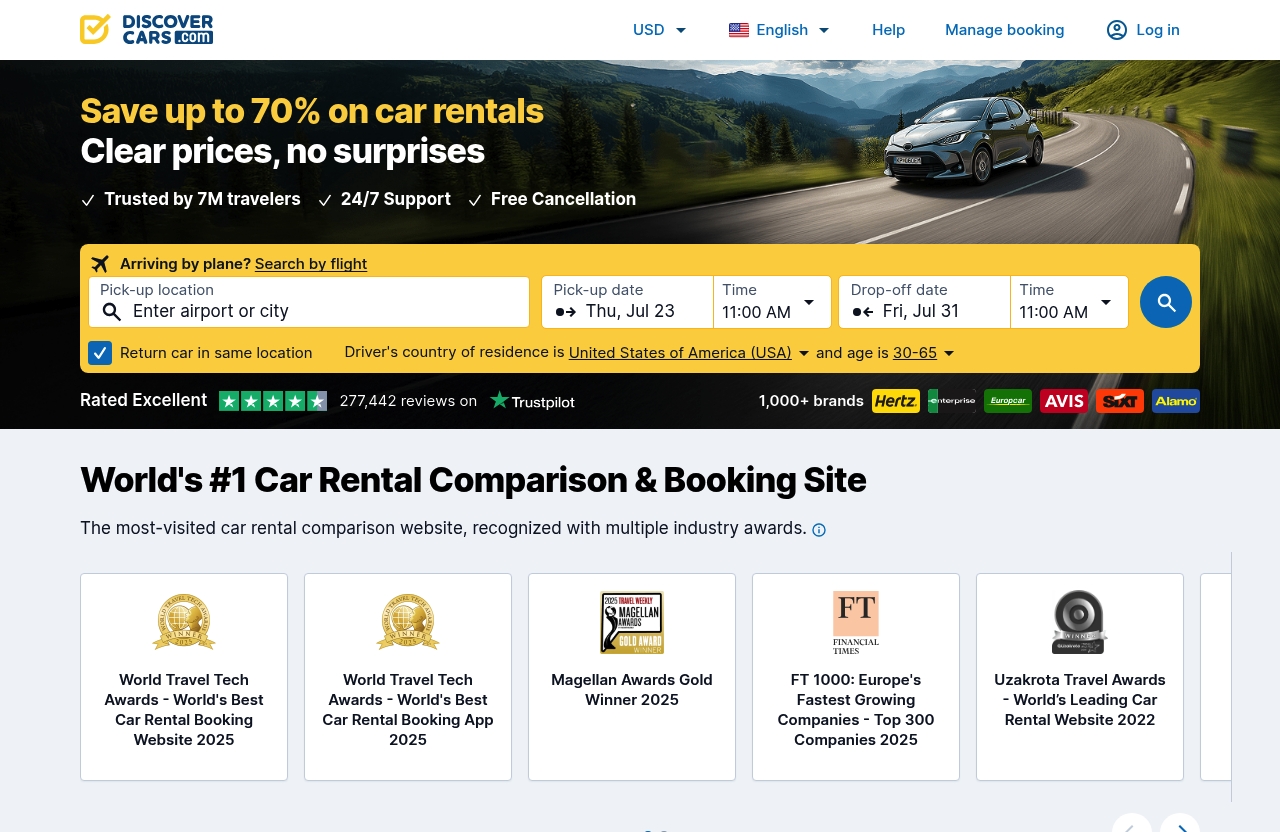
Discovercars states that it offers free cancellation, clear prices, 24/7 support, and driver-country selection during the search process. Those details can be useful when comparing options as an international visitor or booking an airport rental, but always read the individual rental offer’s terms.
Use comparison sites before you buy
A comparison tool gives you time to evaluate rental deals and optional coverage away from the counter. You can compare U.S. rental options through Discovercars and then match the available terms against your insurer and card benefits before making a decision.
This site may earn a commission from qualifying bookings, at no extra cost to you. The important step is still to read the specific rental agreement: coverage terms can differ between suppliers even when the vehicle class and pickup location look similar.
Common mistakes to avoid at the rental counter
A rushed decision is one of the biggest sources of unnecessary usa car rental insurance spending. Take a few minutes to inspect the agreement and ask questions about any product you do not understand.
Assuming your home policy applies everywhere
Do not assume that a personal auto policy automatically covers every rental, every vehicle, every driver, and every destination. U.S. policies can have exclusions, and foreign policies may not apply to rentals in the United States at all.
Confirm the rental length, vehicle category, deductible, authorized drivers, and territory. If you plan to drive beyond the United States, verify that separately.
Confusing credit card coverage with full protection
A card benefit can be excellent for covered vehicle damage, but it often does not provide liability insurance, medical protection, personal-property coverage, or roadside help. It may also be secondary, leaving your own policy to handle the first part of the claim.
Bring the benefit guide and understand the required steps. If you have not verified eligibility, do not treat credit card rental car insurance as guaranteed protection.
Not documenting the car before driving off
Before leaving the lot, walk around the vehicle slowly. Photograph all sides, the wheels, windshield, roof, interior, fuel gauge, and odometer.
Also:
- Ask an employee to note pre-existing damage on the agreement
- Record the date and time of your photos
- Check that the license plate matches the paperwork
- Test lights, wipers, locks, and basic controls
- Keep the rental agreement, inspection record, and return receipt
Repeat the photo process when returning the vehicle. This documentation can be useful even when you have a damage waiver.
Step-by-step checklist before you rent in the USA
Use this checklist to make a calm, informed usa car rental insurance choice.
Before you book
- Review your personal auto policy for liability, collision, comprehensive, deductible, and rental exclusions.
- Call your insurer if the policy language is unclear.
- Review your credit card’s current rental benefit guide.
- Confirm whether card coverage is primary or secondary.
- Check that your rental vehicle, rental duration, and U.S. pickup location qualify.
- Decide whether you need extra liability, a rental car damage waiver, medical protection, belongings protection, or roadside assistance.
- Compare the total rental terms, not just the base rate.
Before you pick up the car
- Read the booking confirmation and note what coverage is already included.
- Bring your driver’s license, payment card, insurance information, and card-benefit details.
- Confirm every authorized driver is listed on the agreement.
- Ask what liability coverage is included and what remains your responsibility.
- Ask for plain-language clarification on CDW/LDW exclusions before accepting it.
- Decline only the coverage you have genuinely verified is duplicated.
- Do not let an unfamiliar label push you into a quick decision.
Before you drive away
- Inspect and photograph the vehicle inside and out.
- Make sure pre-existing damage is recorded.
- Check fuel level, mileage, tires, windshield, mirrors, and warning lights.
- Save the rental company’s accident and roadside contact information.
- Read the rules on tolls, fuel, geographic limits, and returning the vehicle.
- Keep all paperwork until any deposit and final charges are settled.
The best usa car rental insurance plan is not necessarily the biggest package. It is the one that gives you adequate liability and vehicle-damage protection, fits your deductible and trip risk, and does not duplicate coverage you already have.
Free cancellation on most bookings · No hidden fees
FAQ
What insurance do I need for car rental in the USA?
Most renters need to understand liability coverage and protection for damage to the rental vehicle. You may already have these through a personal auto policy or eligible card benefit, but you must verify the limits, deductibles, and exclusions. If you lack adequate coverage, rental-company liability protection and CDW/LDW may be worth considering.
What is the best insurance to get when renting a car?
The best option depends on your existing coverage, deductible, vehicle type, trip length, and comfort with risk. Often, the best value is the least expensive non-duplicate protection that closes a real gap, such as rental-car damage coverage or stronger liability protection.
Do you really need the extra insurance when renting a car?
Not always. Many U.S. drivers already have some rental protection through their personal policy or credit card, so buying every counter add-on can create duplicate coverage. Extra protection can be sensible if you have no auto policy, high deductibles, limited card benefits, uncertain liability coverage, or are traveling from abroad.
Does my US insurance cover international car rental?
It depends on your insurer, policy, destination, vehicle, and rental terms. Many U.S. policies have limits or exclusions outside the United States and Canada, so contact your insurer before an international rental. Do not assume the same usa car rental insurance protection applies abroad.