
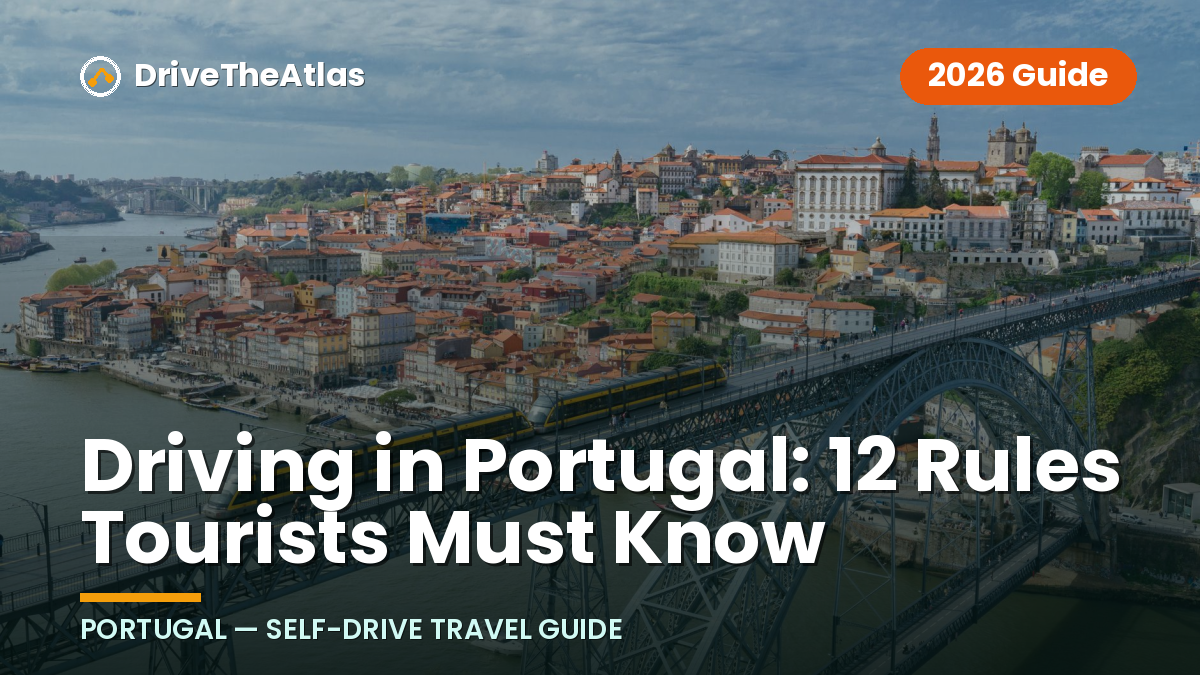
Driving in Portugal is usually manageable for tourists, especially outside Lisbon and Porto, but it is not something to treat casually. The highways are generally good, the scenery is excellent, and road trips can be the best way to reach beaches, villages, wine regions, and inland viewpoints.
The surprises come from narrow streets, fast local drivers, toll roads, roundabouts, parking rules, and unfamiliar signs. If you are driving in Portugal for the first time, the key is to understand the laws and the driving culture before you collect the rental car.
Rules and rental requirements can change, and enforcement practices may vary. Before your trip, confirm current details with your rental company, Portugal’s official tourism and transport sources, and your own government travel advice.
Free cancellation on most bookings · No hidden fees
Driving in Portugal: What Tourists Need to Know First
Is driving in Portugal hard for tourists?
For most confident drivers, driving in Portugal is not especially difficult. Roads between major towns are often well maintained, motorways are efficient, and traffic signs use standard European symbols.
The harder parts are usually practical rather than legal: finding parking in historic centers, navigating steep lanes, understanding electronic tolls, and keeping calm when local drivers follow closely or change lanes quickly.
In my experience planning Portugal road trips, the stress level depends heavily on where you drive. A rental car is wonderful in the Algarve, Alentejo, Douro Valley, and rural northern Portugal, but less fun inside Lisbon, Porto, or old hill towns with tiny streets.
Who this guide is for: Americans, UK visitors, EU drivers, and first-timers
This guide is for tourists who want clear, practical advice on driving in Portugal for foreigners. That includes Americans, Canadians, UK visitors, EU travelers, Australians, and anyone renting a car after arriving by plane or train.
It is also written for people wondering about driving in Portugal left or right, license rules, road signs, tolls, and what actually happens on the road. The legal basics are fairly straightforward, but rental-company rules can be stricter than national requirements.
If you are comparing travel options, use this article as a road-readiness checklist rather than a replacement for official rules. The Portuguese mobility authority IMT, the European Commission road safety pages, Visit Portugal, and your rental provider are useful sources to confirm details before departure.
Quick verdict: when driving is worth it and when to skip it
Driving in Portugal is worth it if your itinerary includes rural areas, beach-hopping, vineyards, national parks, surf towns, or small villages with limited public transport. It is especially useful in the Algarve, Alentejo, Douro Valley, Peneda-Gerês, and parts of the Silver Coast.
Skip the car, or delay collecting it, if you are spending only a few days in Lisbon or Porto. Both cities have good public transport, heavy traffic, expensive parking, and historic neighborhoods where a car can feel like a burden.
A smart compromise is to visit the city first, then rent a car when you are ready to leave. This reduces airport stress, parking costs, and the chance of making beginner mistakes while tired from travel.
The 12 Rules Tourists Must Know Before Driving in Portugal
1. Drive on the right and overtake on the left
Portugal drives on the right-hand side of the road. If you are from the US, Canada, or most of mainland Europe, this will feel familiar; if you are from the UK, Ireland, Australia, or New Zealand, build in adjustment time.
What to do: Keep right except when overtaking, and take extra care when leaving petrol stations, car parks, or quiet rural roads where habit can take over.
Common tourist mistake: UK visitors sometimes drift toward the left side after a stop or when turning onto an empty road. Say “right side, right side” out loud if needed during your first hour.
2. Carry the right documents at all times
Portugal driving rules require you to have proper identification and vehicle documents available. For tourists, that usually means your driving license, passport or ID, rental agreement, insurance documents, and any paperwork the rental company gives you.
What to do: Keep documents in a safe but accessible place, not buried in luggage.
Common tourist mistake: Assuming a photo of a license or passport is enough. Police may ask for original documents, and rental companies may require physical cards at pickup.
3. Understand whether your license is enough
Driving in Portugal requirements depend on your nationality, license type, and rental provider. EU and UK license holders are generally in a simpler position, while travelers with non-EU licenses should check whether an International Driving Permit is recommended or required by the rental company.
What to do: Ask your rental provider before arrival whether your license is accepted as-is.
Common tourist mistake: Confusing legal eligibility with rental-company policy. A rental desk can refuse a car if your documents do not meet its terms, even if you believe you can legally drive.
4. Obey speed limits, cameras, and sudden limit changes
Portugal speed limits are posted in kilometers per hour, not miles per hour. Limits can change quickly when you enter villages, approach construction zones, or move from a motorway to a national road.
What to do: Watch signs closely and use a navigation app that displays km/h speed limits, but trust road signs first.
Common tourist mistake: Continuing at open-road speed after entering a town. Speed enforcement can happen through cameras, police checks, and rental-car fine forwarding.
5. Know the rules for seat belts, headlights, and phones
Seat belts are compulsory for drivers and passengers. Using a handheld mobile phone while driving is not allowed, and fines can be significant.
What to do: Set navigation before moving, use a proper mount, and keep both hands free. Use headlights when visibility is poor, in tunnels, and whenever signs require them.
Common tourist mistake: Holding a phone at traffic lights “just for a second.” Treat stopped traffic as still driving.
6. Do not assume you can turn right on red
If you are driving in Portugal as American, this is one of the biggest habits to unlearn. Unlike many parts of the US, you generally cannot turn right on red unless a specific sign or signal allows it.
What to do: Stop and wait for the appropriate green light or green arrow.
Common tourist mistake: Rolling through a red light because the road looks clear. That can lead to a fine and, more importantly, a dangerous conflict with pedestrians or cross traffic.
7. Be extra careful with roundabouts and lane discipline
Roundabouts are common throughout Portugal. The general pattern is to yield to traffic already in the roundabout, choose the correct lane, signal clearly, and exit carefully.
What to do: Slow down early, read lane arrows, and avoid last-second lane changes. If you miss your exit, go around again.
Common tourist mistake: Entering too fast or stopping inside the roundabout because you are unsure. Keep moving predictably and do not cut across lanes.
8. Expect toll roads and plan payment in advance
Portugal toll roads are common on major routes, and some use electronic tolling rather than traditional booths. Rental cars may come with an electronic toll device, but policies and fees vary.
What to do: Ask at the rental counter how tolls are billed, whether a transponder is included, and what admin fees apply.
Common tourist mistake: Assuming every motorway has a cash booth. Some roads are electronic only, and unpaid tolls can become a rental-car headache later.
9. Watch for steep, narrow, and winding roads
Driving in Portugal can involve roads that look simple on a map but feel very different behind the wheel. Mountain routes, old villages, island roads, and rural lanes may be steep, narrow, or lined with stone walls.
What to do: Choose a smaller car if your itinerary includes historic towns or countryside lanes. Drive slowly enough to stop within the road you can see.
Common tourist mistake: Renting a large SUV for “comfort” and then struggling through medieval streets, tight parking garages, or cliffside roads.
10. Avoid aggressive local driving habits and keep distance
Driving culture in Portugal can feel assertive. Some locals follow closely, overtake decisively, or move quickly through roundabouts and merges.
What to do: Stay calm, keep your lane, and let faster drivers pass when safe.
Common tourist mistake: Matching local speed or reacting emotionally to tailgating. You are better off being predictable than trying to “drive like a local.”
11. Park legally or risk expensive problems
Parking is one of the most frustrating parts of driving in Portugal for tourists. Historic centers often have restricted streets, resident zones, paid parking, narrow spaces, and confusing curb markings.
What to do: Use official car parks near city centers, read parking signs carefully, and keep payment receipts or app confirmations.
Common tourist mistake: Parking where other cars are parked and assuming it must be legal. Locals may have permits, or enforcement may still tow or ticket visitors.
12. Never drive tired, rushed, or after drinking
Portugal has strict drink-driving laws, and the safest travel rule is simple: do not drink and drive. Fatigue is also a real risk after overnight flights, long lunches, beach days, or mountain routes.
What to do: Plan shorter first-day drives, share driving if possible, and use taxis or rideshares after drinking.
Common tourist mistake: Landing in Lisbon, collecting a car, and immediately driving several hours on little sleep. If your flight arrives tired and jet-lagged, consider staying overnight before starting the road trip.
Documents, License Rules, and Rental Requirements
Can you drive in Portugal with a US license?
Many travelers ask about driving in Portugal with US drivers license documents. In practice, many US visitors rent cars using a valid US license, but you should verify current rules with your rental company and official sources before you travel.
The safest approach is to carry your valid US license, passport, rental agreement, and an International Driving Permit if your rental provider recommends or requires it. An IDP is not a standalone license; it is a translation-style document used alongside your actual license.
For driving in Portugal as American travelers, the biggest risk is not usually the road itself. It is arriving at the rental counter without the documents the company expects.
Do you need an International Driving Permit?
An International Driving Permit may be recommended for non-EU license holders, especially when the license is not in a format easily understood by local authorities. Requirements can vary by nationality, license language, and rental-company policy.
UK license holders should confirm current guidance before travel, especially because driving in Portugal UK license rules and recognition can be affected by broader UK-EU arrangements and rental terms. EU license holders typically face fewer complications, but they still need a valid license.
If in doubt, get an IDP before departure if your country issues one easily and your rental company suggests it. It is usually simpler to arrange before you travel than to solve at the counter.
Passport, insurance, and rental paperwork checklist
Use this checklist before picking up your car:
| Item | Why It Matters |
|---|---|
| Valid driving license | Required to rent and drive |
| International Driving Permit, if applicable | May be requested by rental company or authorities |
| Passport or national ID | Used for identity verification |
| Credit card in main driver’s name | Common rental deposit requirement |
| Rental agreement | Shows you are authorized to drive the vehicle |
| Insurance documents or coverage confirmation | Helps clarify liability and included protection |
| Emergency contact and roadside assistance number | Useful if the car breaks down |
| Toll device information | Prevents confusion on electronic toll roads |
Keep these items accessible during the trip. Do not leave passports or valuables visible in the car when parked.
Minimum age and car-rental basics to confirm before pickup
Rental requirements are not the same as national driving laws. A country may allow someone to drive legally, while a rental company may set a higher minimum age, require longer license history, or charge young-driver fees.
Before booking, confirm the minimum driver age, deposit amount, credit-card rules, insurance excess, fuel policy, mileage limits, border-crossing rules, and toll-billing method. Also check whether additional drivers must be registered.
For driving in Portugal for the first time, I strongly recommend choosing a car you can confidently park and maneuver. Smaller cars are often easier than large vehicles, especially in old towns, coastal villages, and underground garages.
Speed Limits, Road Signs, and Enforcement in Portugal
Common speed limits by road type
Portugal speed limits are shown in km/h and can vary by sign, weather, roadworks, and vehicle type. Always follow posted limits, but these are common general limits for passenger cars:
| Road Type | Common Limit |
|---|---|
| Built-up areas | 50 km/h |
| Rural roads | 90 km/h |
| Main roads / express routes | 100 km/h |
| Motorways | 120 km/h |
These are general reference values, not a substitute for signs. When driving in Portugal, expect limits to drop quickly near villages, schools, curves, junctions, toll areas, and construction zones.
Metric signs: km/h and km
Portugal uses the metric system. Distances are in kilometers, and speed is in kilometers per hour.
If you normally think in miles, remember that 50 km/h is about 31 mph, 90 km/h is about 56 mph, 100 km/h is about 62 mph, and 120 km/h is about 75 mph. This matters because a speed that feels normal in miles can be too fast in a village.
Most Portugal road signs follow European conventions: red circles for restrictions, blue signs for motorways or mandatory directions, triangular signs for warnings, and brown signs for tourist information.
Speed cameras and fines
Speed cameras and police enforcement are part of everyday driving in Portugal. Some cameras are fixed, some are mobile, and some areas use average-speed or controlled-speed zones.
If a rental car receives a fine, the rental company may forward driver details and may charge an administrative fee according to its terms. Fines can arrive after your trip, so do not assume you “got away with it” because nothing happened on the road.
The calmer approach is to drive slightly under the limit when uncertain, especially in towns. This also gives you more time to read signs, spot pedestrians, and avoid sudden lane changes.
Local sign patterns tourists often miss
Tourists often miss signs at the entrance to towns, where the speed limit may reduce without a dramatic change in road appearance. A straight road may look rural but legally be inside a built-up area.
Also watch for one-way streets, bus lanes, resident-only zones, no-entry signs, and parking restrictions. In Lisbon and Porto, navigation apps can sometimes route you toward streets that are legal but stressful, or into areas where parking is impractical.
When driving in Portugal, signs may appear quickly near roundabouts and complex junctions. Slow early so you have time to choose the correct lane.
Free cancellation on most bookings · No hidden fees
Portugal Driving Culture: What Foreign Drivers Should Expect
Roundabouts, merging, and lane positioning
Roundabouts require patience and confidence. Approach slowly, yield properly, and choose a lane based on your exit.
In multi-lane roundabouts, do not cut across lanes at the last second. If you are not positioned correctly, continue around and try again.
Merging can feel fast on motorways and ring roads. Signal early, match traffic speed when safe, and avoid hesitating halfway into a lane.
How Portuguese drivers behave in cities vs. highways
Driving in Portugal feels different depending on the setting. In cities, expect scooters, delivery vans, pedestrians, trams in Lisbon, buses, double-parked vehicles, and impatient lane changes.
On highways, traffic may move smoothly but quickly. Drivers may approach from behind at high speed, especially in the left lane, so move right after overtaking.
On rural roads, locals may know the curves and drive faster than visitors. Let them pass when there is a safe opportunity rather than feeling pressured.
Night driving, mountain roads, and island routes
Night driving can be tiring because road edges, pedestrians, cyclists, animals, and sharp bends are harder to see. Rural lighting may be limited, and mountain roads can feel much narrower after dark.
If your itinerary includes Madeira or the Azores, expect more elevation changes, tunnels, steep roads, and dramatic weather shifts. These places can be rewarding by car, but they require extra patience.
For nervous drivers, daylight is your friend. Plan scenic roads earlier in the day and avoid arriving in unfamiliar hill towns after dark.
When public transport is the smarter choice
Public transport is often smarter in Lisbon, Porto, and between major cities connected by train. If your plan is Lisbon to Porto with only city sightseeing, a car may add cost and stress.
Driving in Portugal is most valuable when you need flexibility. If your route is mostly urban, trains, metro, taxis, rideshares, and occasional tours may be easier.
A good rule: rent for countryside days, not city days. This keeps the best parts of the road trip while avoiding the worst parking and traffic problems.
Tolls, Fuel, Parking, and Other Trip Costs
Toll roads and electronic payment basics
Portugal has an extensive motorway network, and many faster routes involve tolls. Some toll roads have traditional booths, while others use electronic tolling.
Before leaving the rental lot, ask exactly how tolls will be charged. Confirm whether the car has an electronic device, whether there is a daily fee, how tolls are billed, and what happens if you use an electronic-only road.
Portugal toll roads can save major time, especially on longer routes. Just treat tolls as part of your road-trip budget rather than an unexpected penalty.
Parking rules in tourist cities
Parking in Lisbon, Porto, Sintra, Lagos, Évora, Coimbra, and popular beach towns can be limited and expensive. Some areas use paid street parking, resident permits, underground garages, or restricted traffic zones.
If you are staying in an old center, ask your hotel where guests should park before you arrive. “Nearby parking” can mean a steep walk, a tight garage, or a paid lot several blocks away.
When driving in Portugal, I prefer official garages on city days. They cost more than hunting for street parking, but they reduce the risk of fines, towing, damage, and wasted vacation time.
Fuel types and filling up safely
Rental cars in Portugal may use gasoline or diesel. Always confirm the correct fuel type at pickup and check the label near the fuel cap.
Fuel stations are common on motorways and near towns, but rural areas may have fewer options late at night. Many stations accept cards, but it is wise to carry a backup payment method.
Before returning the vehicle, refuel according to your rental agreement. A full-to-full policy can be economical, but only if you return the car with the required amount of fuel.
Budgeting for the full cost of driving
The real cost of driving in Portugal includes more than the daily rental rate. Budget for fuel, tolls, parking, insurance options, extra drivers, child seats, young-driver fees if applicable, and possible one-way rental charges.
Also consider time costs. A rental car can save hours in rural regions but waste time in cities where traffic and parking are difficult.
If you decide a car fits your itinerary, you can compare Portugal rental options through DiscoverCars, a car rental comparison and booking service. Its official homepage highlights “Best Car Rental Deals with Free Cancellation, Compare & Save!” and includes booking management, a help center, member-only deals, and a price guarantee, but always read the specific rental terms before booking.
Best Practices for a Safer, Less Stressful Drive
Before you leave the airport
Do not rush out of the airport parking lot. Take five minutes to adjust mirrors, pair navigation, understand the gearshift, locate lights and wipers, and check the fuel type.
Photograph the car from all sides, including wheels, bumpers, mirrors, windshield, and interior. Make sure existing damage is recorded by the rental company before you drive away.
Review the route before moving. Airport exits can be confusing, and driving in Portugal is easier when you already know the first few turns.
In Lisbon and Porto
In Lisbon and Porto, expect hills, buses, taxis, scooters, pedestrians, tight lanes, and impatient traffic. Avoid rush hour if possible, and do not attempt to sightsee from the driver’s seat.
Use garages instead of circling endlessly for street parking. If your accommodation is in a historic district, ask whether there are access restrictions or recommended arrival routes.
If this is your first European driving experience, consider collecting the rental car after your city stay. Starting a road trip from the edge of town is often calmer than beginning in a dense center.
On coastal and rural roads
Coastal roads can be beautiful but distracting. Pull over safely for photos rather than slowing suddenly in the lane.
Rural roads may include tractors, cyclists, animals, blind bends, stone walls, and locals who know the route well. Keep your speed comfortable and leave extra space.
When driving in Portugal through villages, assume pedestrians may step into the road and parked cars may open doors unexpectedly. Slow driving is not weakness; it is good travel judgment.
What to do if you get stopped or have a breakdown
If police stop you, stay calm, be polite, and provide documents when asked. Do not argue roadside about rules you are unsure of; ask for clarification and keep any paperwork issued.
If you break down, move to a safe place if possible, turn on hazard lights, and contact the rental company’s roadside assistance number. Use reflective safety equipment if supplied and safe to do so.
Do not attempt repairs on a motorway shoulder unless absolutely necessary for safety. Get behind a barrier if possible and wait for professional help.
Should Tourists Rent a Car in Portugal?
Best use cases for renting
A car is ideal for the Algarve beyond the main resort towns, Alentejo villages, Douro Valley viewpoints, surf beaches, remote monasteries, nature parks, and small towns where buses are infrequent.
Driving in Portugal also makes sense if you travel with children, luggage, photography gear, mobility needs, or a flexible itinerary. You can stop at viewpoints, change plans for weather, and reach places that trains do not serve well.
For a classic road trip, the freedom is hard to beat. Just match the car to the route rather than renting the biggest vehicle by default.
When trains and rideshares make more sense
Trains are often better for Lisbon, Porto, Coimbra, and some intercity routes. They remove the stress of parking, tolls, fuel, and city traffic.
Rideshares and taxis can be useful for airport transfers, restaurant nights, and short hops where parking would be difficult. Tours can also be a smart option for wine regions if you plan to drink.
If your itinerary is mostly urban, do not rent out of habit. Portugal is one of those countries where the best choice may be car-free for a few days, then car-based later.
How to choose the right rental car size
Choose the smallest car that comfortably fits your passengers and luggage. Compact cars are easier for garages, old streets, and narrow rural roads.
Automatic cars may cost more or be less available than manuals, so reserve early if you need one. If you only drive automatic, do not assume you can switch at the counter.
For mountain areas, check that the engine feels adequate, but avoid oversized vehicles unless you truly need space. In Portugal, maneuverability often matters more than size.
Why booking with a comparison platform helps
A comparison platform can help you see multiple rental options in one place, compare policies, and filter for terms that matter to your trip. That is useful because rental conditions, deposits, fuel policies, mileage, toll devices, and cancellation rules can vary widely.
DiscoverCars is one such car rental comparison and booking service, with features such as free-cancellation options shown on its homepage, booking management, a help center, member-only deals, and a stated price guarantee. You can compare Portugal rental deals through DiscoverCars if renting a car fits your route.
The bottom line: driving in Portugal is a great choice for the right itinerary, but it is not mandatory for every trip. Rent when it gives you freedom, skip it when it adds stress, and always confirm current rules before you drive.
Free cancellation on most bookings · No hidden fees
FAQ
Is it difficult for an American to drive in Portugal?
It is usually manageable for experienced American drivers, especially because Portugal drives on the right. The biggest adjustments are metric speed limits, no general right turn on red, roundabouts, electronic tolls, narrow streets, and assertive local driving habits.
For driving in Portugal as American visitors, I recommend starting in daylight, avoiding rush hour in Lisbon and Porto, and choosing a smaller rental car. If you are tired after an overnight flight, spend the first night nearby before starting a long drive.
Can I drive in Portugal with a US license?
Many US travelers can rent and drive with a valid US license, but you should confirm current requirements with your rental company before arrival. Some companies may recommend or request an International Driving Permit, especially for non-EU licenses.
For driving in Portugal with US drivers license documents, carry the physical license, passport, rental agreement, insurance paperwork, and IDP if applicable. Remember that an IDP supports your license; it does not replace it.
What not to do in Portugal as a tourist while driving?
Do not ignore speed limits, assume you can turn right on red, block roundabouts, drive in bus lanes, park illegally, use a handheld phone, or drink and drive. Also avoid reacting aggressively to tailgating or fast local drivers.
The safest approach to driving in Portugal is to be calm, predictable, and conservative. Give yourself extra time, especially in cities, old towns, rural lanes, and mountain areas.
Can I turn right on red in Portugal?
No, you generally cannot turn right on red in Portugal unless a specific sign, signal, or green arrow allows it. This is an important difference for North American drivers.
When in doubt, wait for the proper green signal. Treat red lights as full stops, even if the road appears clear.
Related Reading
- Portugal Toll Roads Explained: Via Verde Guide 2026
- Portugal Car Rental Insurance: What Travelers Need to Know in 2026
- Car Rental at Lisbon Airport: 2026 Pickup Guide, Documents, and Mistakes to Avoid